


Crochet Cardinal Couple Wreath Pattern
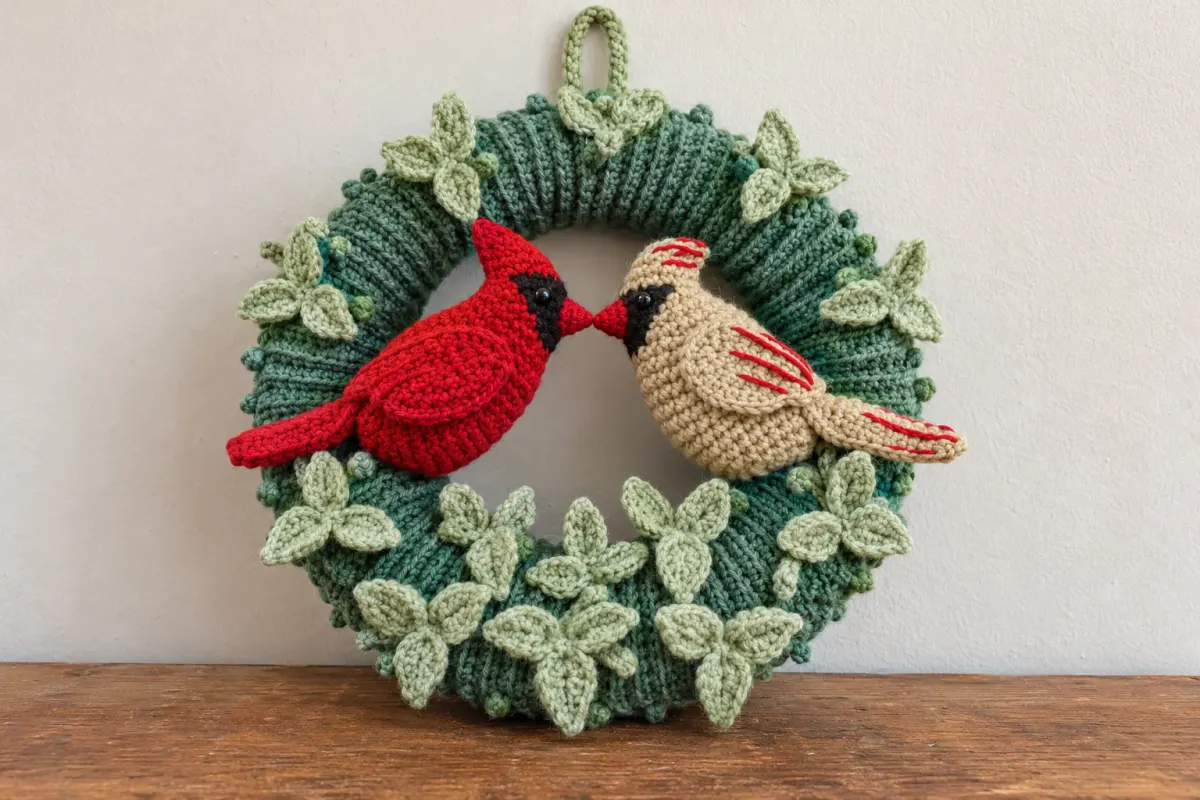
This crochet cardinal couple wreath combines a textured green cover, clusters of pointed leaves and two small birds facing each other in the center. The male cardinal is cherry red; the female is buff with red embroidered markings. Their beaks meet in the finished arrangement. A braided yarn loop completes the wreath without adding a separate ribbon bow or an unprovided floral decoration.
 Save
The supplied design uses US crochet terms and is rated easy. Its approximate finished diameter is 12 inches [30.5 cm]. The wreath cover and leaves use the larger hook, while the birds use the smaller hook. Keep those tool choices and the two gauges separate as you move between the flat fabric, leaf pieces and stuffed bird construction.
Materials and gauges
The supplied medium-weight category 4 yarn specification is 7 oz/198 g, 364 yds/333 m. Colors and quantities are A Frosty Green (0661), one ball or 68 yds/62 m; B Light Sage (0631), one ball or 320 yds/293 m; C Cherry Red (0319), one ball or 48 yds/44 m; D Black (0312), one ball or 10 yds/9 m; and E Buff (0334), one ball or 39 yds/35 m.
Use US 7 (4.5 mm) and US I/9 (5.5 mm) hooks, or sizes needed to obtain gauge, plus a yarn needle, stitch marker, 12-inch [30.5 cm] foam wreath form, four 5 mm safety eyes and fiberfill. Glue is optional in the source's final bird attachment step. Gauge is 12 sc and 15 rows to 4 inches [10 cm] with the larger hook, and 15 sc and 16 rows to 4 inches [10 cm] with the smaller hook.
Abbreviations and special stitches
Approx means approximately; beg means beginning; ch means chain; cont means continue; dc means double crochet; hdc means half double crochet; PM means place marker; rem means remaining; rep means repeat; rnd means round; RS means right side; sc means single crochet; sl st means slip stitch; st means stitch; tog means together; WS means wrong side; and yoh means yarn over hook.
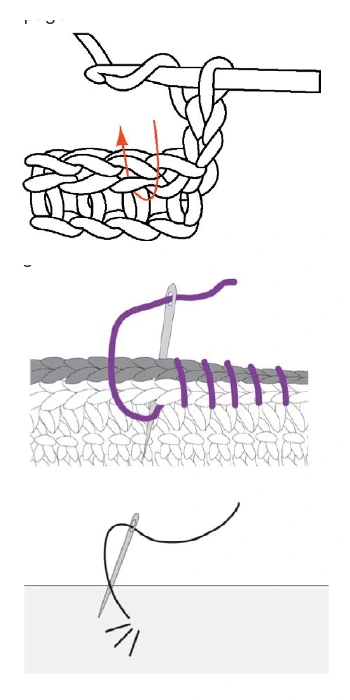
Hdchb: Work one hdc into the horizontal bar created below the previous row, below the loops normally worked on the wrong side. Picot: Chain 3 and slip stitch into the first chain. Sc2tog or sc3tog: Draw up a loop in the next stitch two or three times, respectively, then yarn over and draw through all loops. A beginning chain 2 does not count as a stitch; a beginning chain 3 counts as dc.
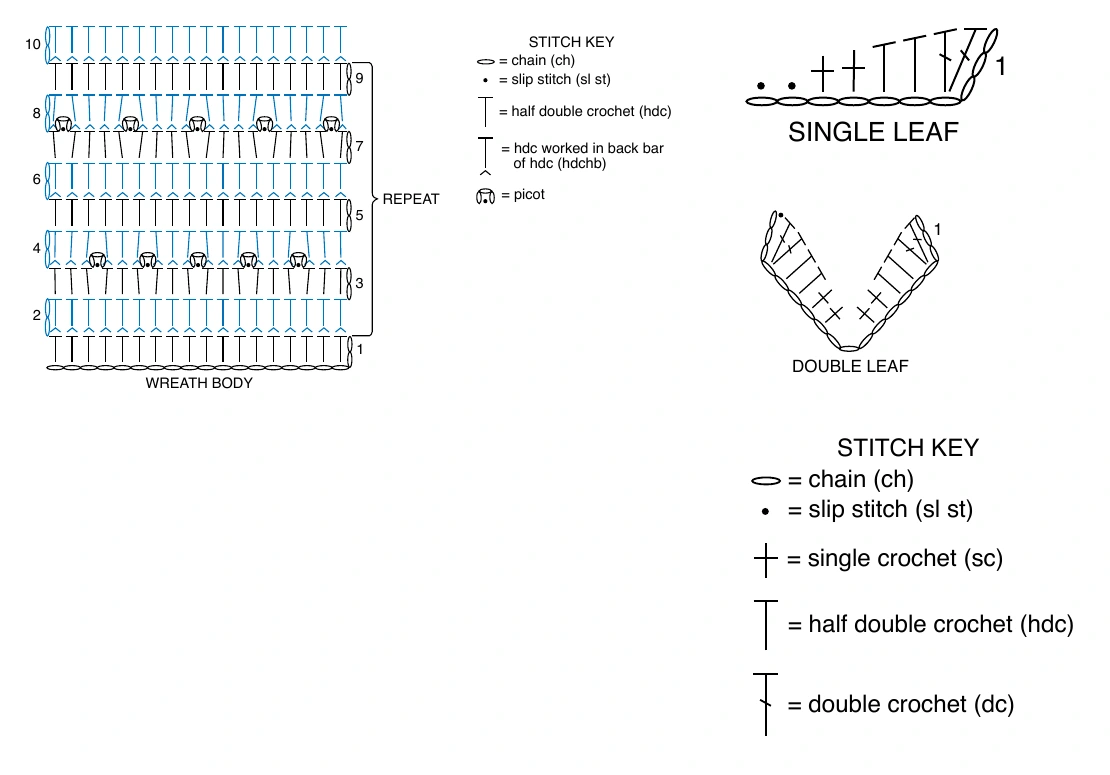
Work the textured wreath base
With B and the larger hook, chain 20.
- Row 1, RS: Work 1 hdc in the third chain from the hook and every remaining chain. Turn: 18 hdc.
- Row 2: Ch 2, 1 hdchb in each hdc across. Turn.
- Row 3: Ch 2, 1 hdc in each of the first three stitches, then (picot, 1 hdc in each of the next three stitches) five times. Turn: 18 hdc and five picots.
- Row 4: Repeat Row 2.
- Row 5: Ch 2, 1 hdc in each stitch to the end. Turn.
- Row 6: Repeat Row 2.
- Row 7: Ch 2, 1 hdc in the first stitch, then (picot, 1 hdc in each of the next four stitches) four times. Picot, 1 hdc in the last stitch. Turn: 18 hdc and five picots.
- Row 8: Repeat Row 2.
- Row 9: Repeat Row 5.
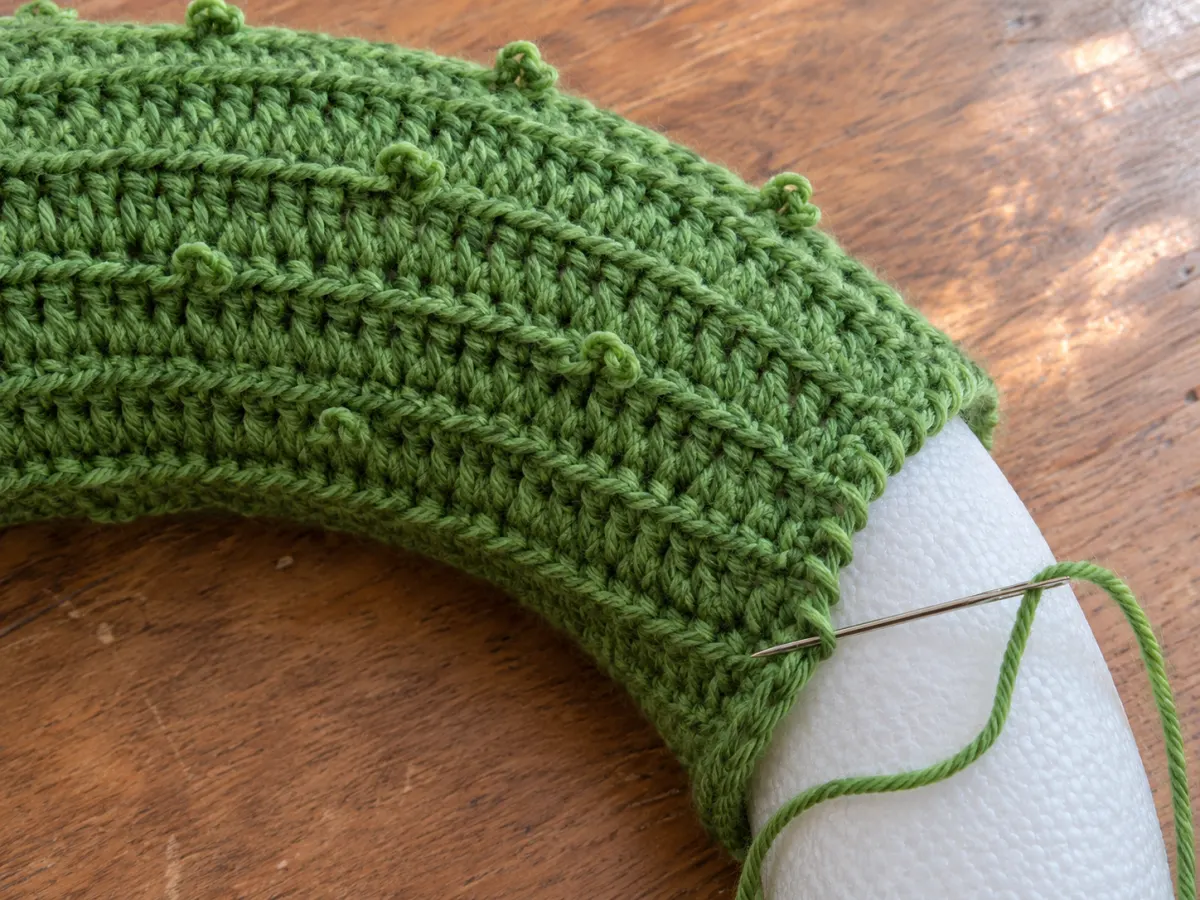
Repeat Rows 2–9 until the work measures 76 inches [193 cm] from the beginning, ending on a WS row. Fasten off with a long sewing tail. This is the source's printed strip length; it has not been replaced with a circumference calculated from the foam form. Wrap the fabric around the form and whipstitch its long edges together, then whipstitch the foundation chain and final row together.
 Save
Make twenty three-leaf bundles
For a single leaf, make twenty with A and the larger hook. Chain 10. Work 2 dc in the fourth chain from the hook, 1 hdc in each of the next two chains, 1 sc in each of the next two chains and 1 sl st in each of the final two chains. Fasten off with a long sewing tail.
For a double leaf, make twenty with A and the larger hook. Chain 19. Work 2 dc in the fourth chain from the hook, 1 hdc in each of the next two chains and 1 sc in each of the next two chains. Skip three chains, work 1 sc in each of the next two chains, 1 hdc in each of the next two chains and 2 dc in the next chain. Skip the next two chains and slip stitch in the last chain. Fasten off and weave in the ends.
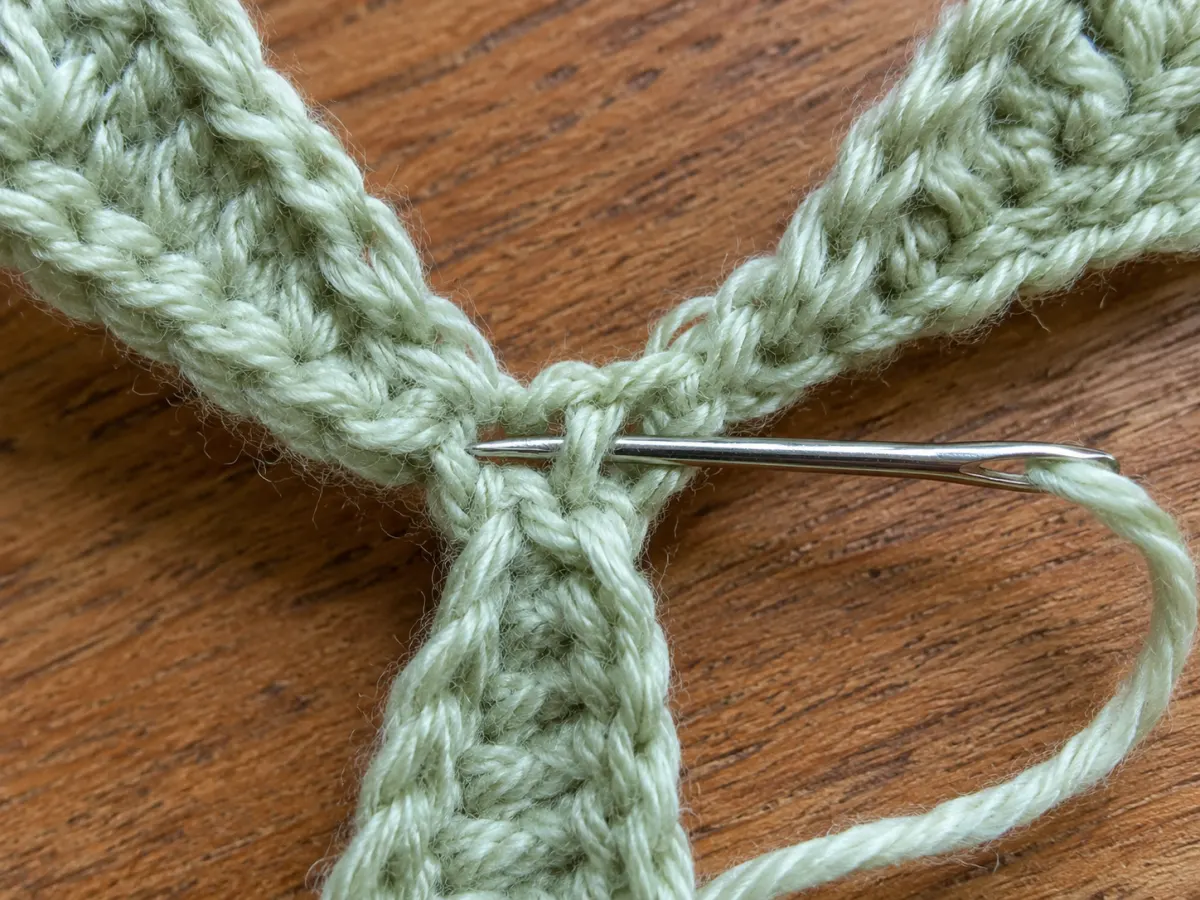
Insert a single leaf's thinner end into the double leaf's ch-3 space so that the single leaf sits on its right side. With the single leaf's long tail and the yarn needle, sew the pieces together at the ch-3 space. Do not break the tail. Each bundle contains one single and one double leaf, giving three pointed leaves in the combined piece.
 Save
Cardinal color choices and working notes
Make one bird using C as Color 1 for the male, and one using E as Color 1 for the female. Use D wherever the black color is specified. Unless instructed otherwise, do not join the bird's rounds: work in a spiral with a marker in the first stitch and move it as the rounds progress.
For a color change, work to the final two loops on the hook, draw the new color through both and continue. Carry the unused color along the top of the preceding row and work new stitches around it unless directed otherwise. This retains the source method for positioning the small black face area.
Cardinal body and crest
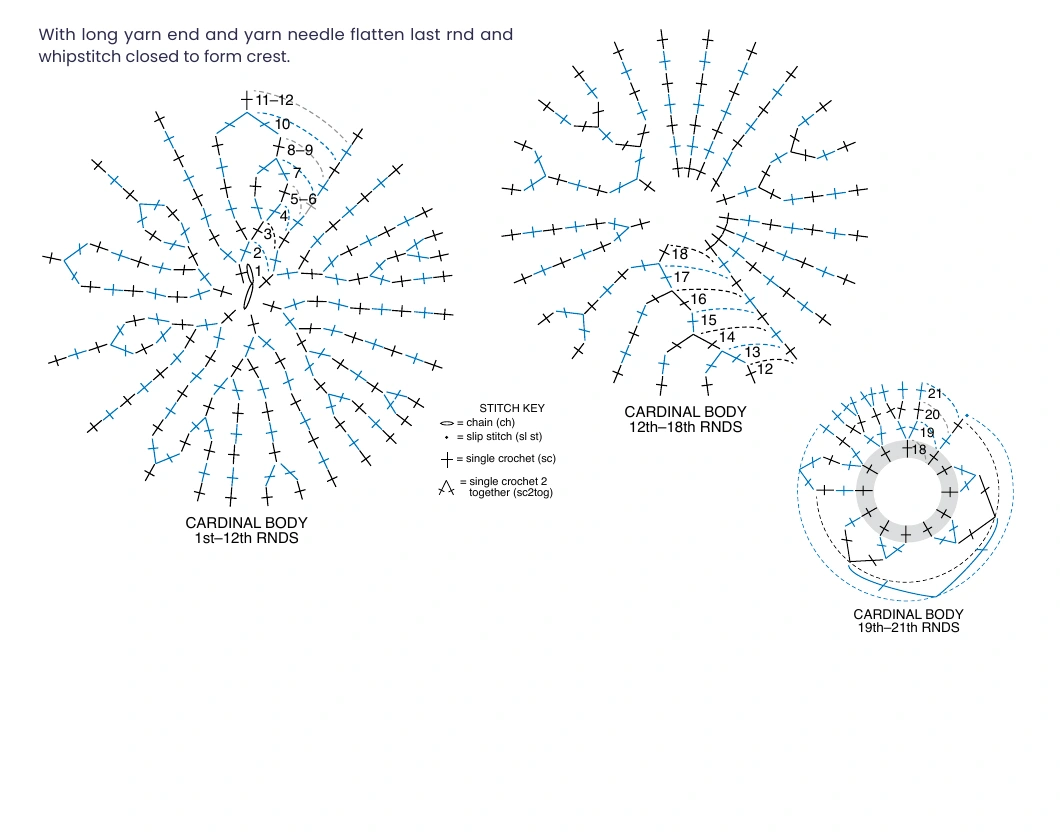
With Color 1 and the smaller hook, chain 2.
- Round 1: Work 6 sc in the second chain from the hook. Do not join. Mark the beginning: 6 sc.
- Round 2: Work 2 sc in each sc: 12 sc.
- Round 3: Work (2 sc in the next sc, 1 sc in the next sc) six times: 18 sc.
- Round 4: Work (2 sc in the next sc, 1 sc in each of the next two sc) six times: 24 sc.
- Rounds 5 and 6: Work 1 sc in each sc.
- Round 7: Work (sc2tog, 1 sc in each of the next two sc) three times, then (2 sc in the next sc, 1 sc in each of the next three sc) three times: 24 stitches.
- Rounds 8 and 9: Work 1 sc in each sc.
- Rounds 10–12: Repeat Rounds 7–9.
- Round 13: Work (sc2tog, 1 sc in each of the next two sc) three times, then 1 sc in each of the next twelve sc: 21 stitches.
- Round 14: Work (sc2tog, 1 sc in each of the next five sc) three times: 18 stitches.
- Round 15: Work 1 sc in each of the next ten sc. Change to D and work 1 sc in each of the next four sc. Change to Color 1 and work 1 sc in each of the next four sc.
- Round 16: With Color 1, sc2tog, 1 sc in each of the next four sc, sc2tog and 1 sc in the next sc. Change to D; work 1 sc in each of the next three sc, sc2tog and 1 sc in each of the next two sc. Change to Color 1 and work 1 sc in each of the next two sc: 15 stitches. Stuff firmly and continue stuffing as work progresses.
- Round 17: With Color 1, sc2tog three times. Change to D and work 1 sc in each of the next eight stitches. Change to Color 1 and work 1 sc in the next sc: 12 stitches.
- Round 18: With Color 1, work 1 sc in each of the next three stitches. Change to D and work 1 sc in each of the next eight stitches. Break D, change to Color 1 and work 1 sc in the next sc.
- Round 19: With Color 1, work 2 sc in each of the next three sc, 1 sc in each of the next two stitches, sc2tog three times and 1 sc in the next sc. Insert the eyes between stitches 4 and 5 and between stitches 10 and 11 of Round 18. Do not stuff the final two rounds.
- Round 20: Work (1 sc in the next stitch, 2 sc in the next stitch) twice, then 1 sc in each of the next three stitches, sc2tog twice and 1 sc in the next sc: 12 stitches.
- Round 21: Work 1 sc in each of the next three sc, 2 sc in each of the next two sc, 1 sc in each of the next two stitches and sc2tog twice. Sl st in the next stitch and fasten off with a long end.
Flatten the final round and whipstitch it closed with the long end to form the crest. Leaving the final two rounds unstuffed is part of that finishing step; it is not an instruction to omit stuffing from the entire bird.
Cardinal wings
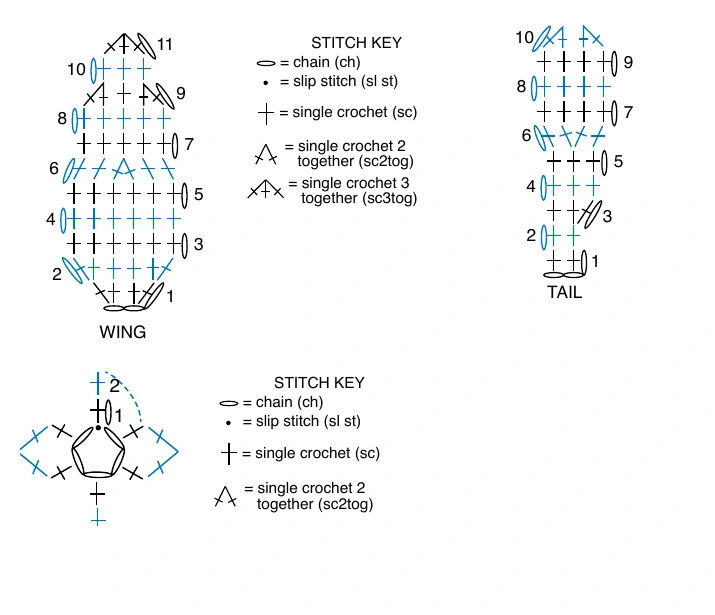
Make two for each bird using the smaller hook and Color 1. Chain 3.
- Row 1: Work 2 sc in the second chain from the hook and 2 sc in the final chain. Turn: 4 sc.
- Row 2: Ch 1, 2 sc in the first sc, 1 sc in each of the next two sc and 2 sc in the last sc. Turn: 6 sc.
- Rows 3–5: Ch 1, 1 sc in each sc. Turn.
- Row 6: Ch 1, 1 sc in each of the first two sc, sc2tog, 1 sc in each of the last two sc. Turn.
- Rows 7 and 8: Ch 1, 1 sc in each stitch. Turn.
- Row 9: Ch 1, sc2tog, 1 sc in the next sc, sc2tog. Turn.
- Row 10: Ch 1, 1 sc in each sc. Turn.
- Row 11: Ch 1, sc3tog. Do not turn.
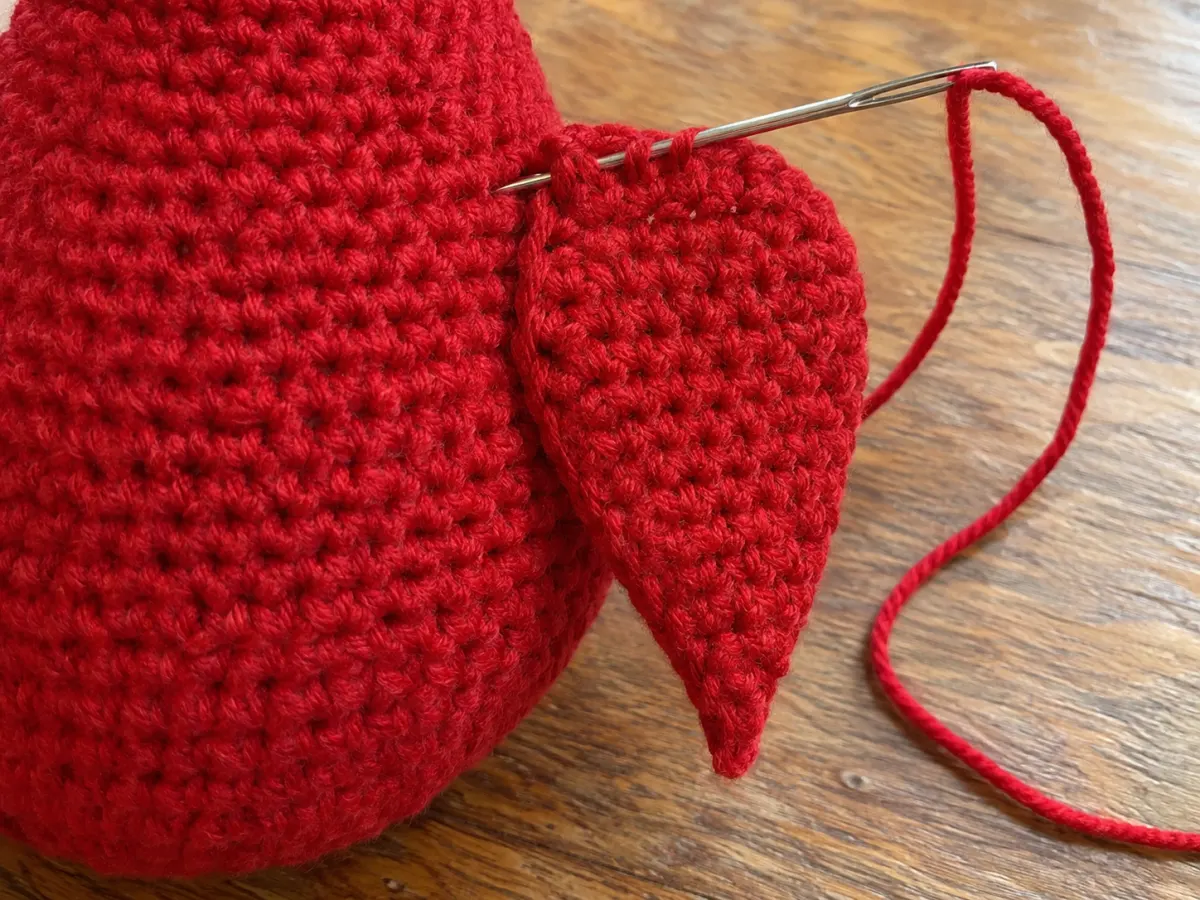
For the edging, ch 1 and work sc evenly around the wing. Join to the first sc and fasten off with a long sewing end. Pinch the final row into a point and sew it together to form the wing tip. Sew the remaining wing rows to the body sides as in the source arrangement, leaving the wing tips unsewn.
 Save
Cardinal tail and beak
For the tail, with the smaller hook and Color 1, chain 3 with a long beginning end. Row 1, RS: work 1 sc in the second chain from the hook and 1 sc in the next stitch; turn: 2 sc. The source calls that final foundation stitch “sc,” although it is still in the starting chain; the two-stitch result is retained.
Row 2: ch 1, 1 sc in each sc; turn. Row 3: ch 1, 2 sc in the first sc and 1 sc in the last sc; turn: 3 sc. Rows 4 and 5 repeat Row 2. Row 6: ch 1, 1 sc in the first sc, 2 sc in the next sc and 1 sc in the last sc; turn: 4 sc. Rows 7–9 repeat Row 2. Row 10: ch 1, sc2tog twice; turn.
For the RS edging round, ch 1 and work sc evenly around the tail. Join to the first sc and fasten off. With the long beginning end, sew the tail to the body back over Rounds 6 and 7, centered between the wings.
For the beak, use the smaller hook and C for both birds. Chain 5, leaving a long beginning end, and slip stitch into the fifth chain from the hook to form a ring. Round 1: ch 1, 6 sc in the ring; do not join and mark the beginning. Round 2: work (1 sc in the next sc, sc2tog) twice: 4 stitches. Sl st in the next stitch and fasten off with a long end. Draw that end through the stitch tops and cinch tightly. Use the long beginning end to sew the beak between the eyes over Rounds 17 and 18.
Embroidery, placement and hanging loop
With C, embroider straight-stitch markings on the female bird's crest, tail and wings, following the supplied arrangement. Sew the leaf bundles to the wreath front, beginning at the bottom, with their sewn ends pointing toward the bottom. Place most bundles at the bottom and space the remaining ones around the sides and top.
Sew, or optionally glue, the birds into the wreath center facing each other with their beaks touching. For the hanging loop, cut three 10-inch [25.5 cm] lengths of B. Knot the ends together, braid the full length and knot both braid ends together into a loop. Pull it through the back at the wreath's top edge and pass the loop through itself to secure it.
Source technical charts
 Save
 Save
 Save
 Save
Useful questions
How many leaf bundles are required?
Make twenty single leaves and twenty double leaves, then join one of each into twenty three-leaf bundles. The quantity refers to bundles, not sixty separately constructed single-leaf pieces.
Do the birds use different beak colors?
No. Both beaks use C, Cherry Red. Color 1 changes between male and female for the body, wings and tail, but the beak's explicit color does not change.
Should the wing tips be sewn flat?
The source says to pinch and sew the last row into a pointed tip, then attach the remaining wing rows without sewing down that tip. Preserve that distinction when positioning the wings.
Is this a toy pattern?
The project is a wreath decoration using a foam form, safety-eye hardware and optional glue. No toy testing, age suitability or safety certification is claimed.
Keep the larger-hook cover and leaf work separate from the smaller-hook bird pieces, then complete the paired arrangement and braided loop. For more project updates, visit our Facebook page and Pinterest page.