


Crochet Macarons: Small Stuffed Treats in Six Color Combinations
Edited by Nora
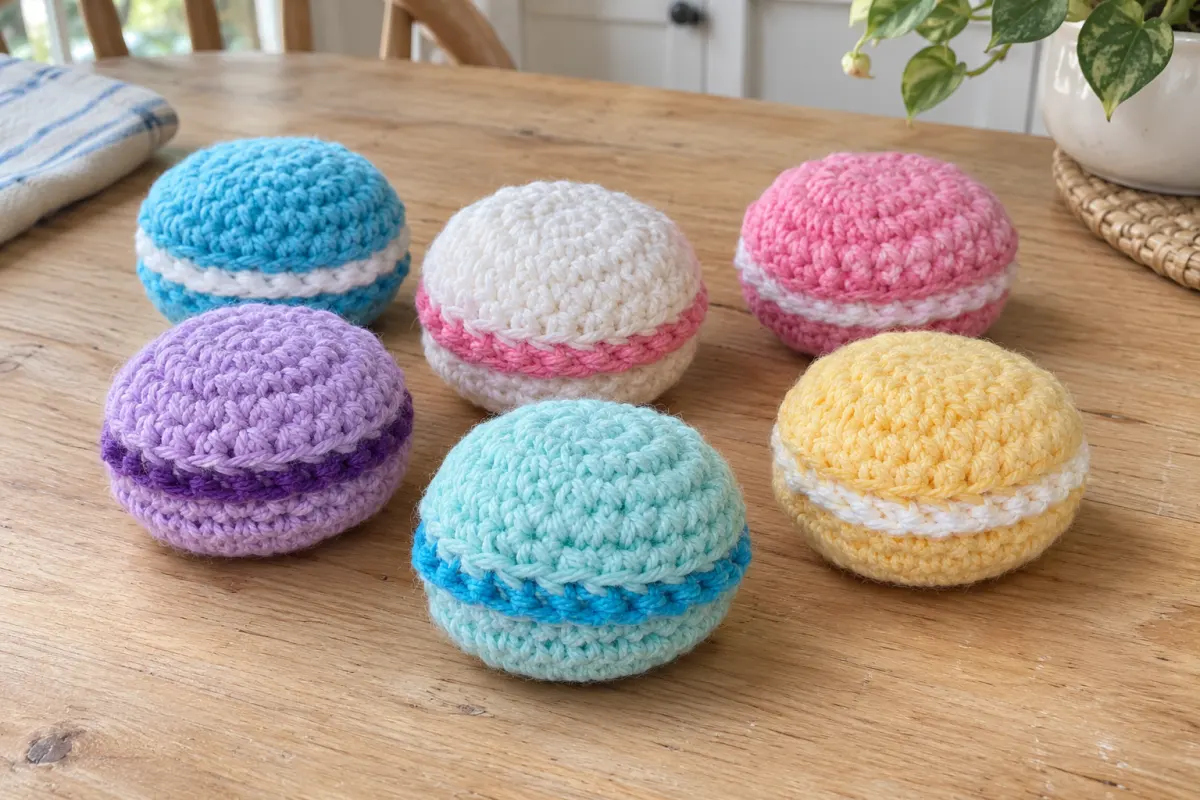
Two shallow crochet halves and a contrasting joining round give these little macarons their sandwich-like shape. The outer shells are worked in the main color, then the contrast yarn becomes the visible filling as the halves are joined. A light amount of stuffing keeps the finished piece rounded without hiding that colored seam.
The supplied pattern is marked easy and uses US terms. Each macaron is approximately 2½ inches (6 cm) in diameter. These are crocheted decorative pieces, not food; the instructions contain no edible ingredients.
 Save
Prepare the shells and filling colors
Think of each macaron as two matching main-color pieces joined by one contrasting edge. Label the selected yarns MC and A before beginning, especially if you are making several versions in the same session. Two of the blue combinations reverse the main and contrast roles, so keeping the names beside the yarn is more reliable than remembering “the blue one.”
Complete both shell halves for one macaron before starting another combination. Lay them together to compare their size, stitch count and tension. They should match because the second half repeats the first-half directions. A mismatch is a reason to check the rounds, not a reason to invent an extra joining stitch to make the edges meet.
The printed yarn ball sizes describe the supplied yarn format. They are not a measured allowance for a single finished macaron. Avoid treating the entire ball weight as the amount used by one piece or claiming a precise number of pieces per ball; the source does not provide that yield. Keep enough of the chosen contrast color available for the complete joining round.
Read the shaping before beginning
The early rounds expand the circle, while the final decrease round gives the shell its shallow rounded shape. Count at the end of each round and compare with the stated total before going on. In particular, round 4 reaches 24 single crochet and round 5 finishes with 20 stitches. Those totals describe different stages, not two alternative versions of the same round.
A removable marker can help you see the first stitch while counting, but follow the source's joins rather than changing the work into an unjoined spiral. Keep the starting chain separate from the stitch count wherever the instructions indicate. An accidental extra stitch near the join can make one shell larger and make the later seam look uneven.
Check gauge with the chosen yarn and hook. Small decorative pieces can still change noticeably when tension varies. The listed diameter is approximate and assumes the intended fabric. If you substitute yarn, the pattern supplies no revised rounds or exact finished size for the new material.
Make the contrasting seam visible
The joining round is also the visible “filling,” so work through the instructed back loops of both halves. Identify the loops on each piece before pulling the contrast yarn through. Working through a different pair of loops changes the edge appearance and should not be used as an unnoticed substitute for the written method.
Keep the halves aligned as you join. After the first 12 joining single crochet, add the light stuffing described in the instructions, then complete the round. The partly open seam gives you access to the inside at that stage. Trying to stuff the piece only after closing the join would require reopening work and is not the source's sequence.
Spread the filling gently between the shells rather than packing a dense lump into the center. The aim is a small rounded textile ornament with a clearly visible contrasting seam, not a tightly inflated ball. The shells should retain their matching outline, and the joining stitches should not be pulled so hard that the filling color disappears into the edge.
Finish by securing yarn ends inside the stitched fabric and checking that the opening is completely closed. These pieces resemble sweets but are not edible, and the source does not establish toy-safety testing. Keep them separate from real food and consider small-piece hazards when deciding where to display them. For storage, place them loosely rather than compressing the little shells under heavier craft supplies.
Materials, hook and gauge
The source lists yarn in these ball sizes: solids, 2.5 oz (70.9 g), 120 yd (109 m); ombres, 2 oz (56.7 g), 95 yd (86 m). Use a size U.S. G/6 (4 mm) crochet hook, or the size needed to obtain gauge, plus stuffing.
Gauge: 15 sc and 16 rows = 4 inches (10 cm). The source gives color pairings rather than a separate measured quantity per individual macaron.
Choose one of the six versions
- Version I: MC Robin's Egg (01215); A Hot Blue (01742).
- Version II: MC Soft Violet (00093); A Grape (00071).
- Version III: MC White (00001); A Strawberry Ombre (00144).
- Version IV: MC Yellow (00010); A White (00001).
- Version V: MC Hot Blue (01742); A Robin's Egg (01215).
- Version VI: MC Strawberry Ombre (00144); A White (00001).
MC is used for both shell halves. A is used to join them. Keep those roles separate when preparing the yarn, especially for the two blue versions that reverse the colors.
Abbreviations
Approx = approximately; ch = chain; rep = repeat; rnd = round; sc = single crochet; sl st = slip stitch; st or sts = stitch or stitches. Sc2tog: draw up a loop in each of the next two stitches, yarn over hook and draw through all loops on the hook.
Step 1: crochet the first half
With MC, ch 2. Join each round with a slip stitch as directed rather than working an unjoined continuous spiral.
- Round 1: Work 6 sc in the second ch from the hook. Join with sl st to the first sc.
- Round 2: Ch 1, work 2 sc in each sc around. Join with sl st to the first sc. 12 sc.
- Round 3: Ch 1, *1 sc in the next sc, 2 sc in the next sc. Repeat from * around. Join with sl st to the first sc. 18 sc.
- Round 4: Ch 1, *1 sc in each of the next 2 sc, 2 sc in the next sc. Repeat from * around. Join with sl st to the first sc. 24 sc.
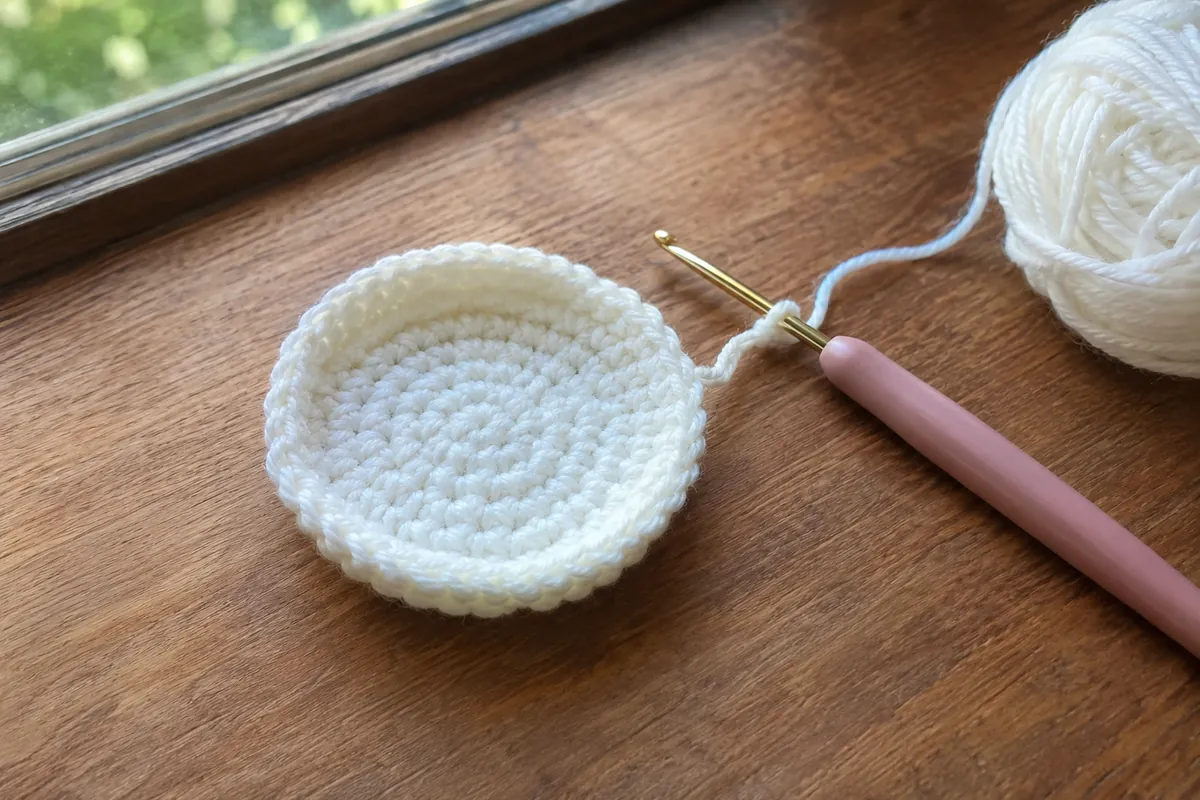
- Round 5: Ch 1, *1 sc in each of the next 4 sc, sc2tog. Repeat from * around. Join with sl st to the first sc. 20 stitches. Fasten off.
Count the final round before making the second half. The increase rounds expand the circle, while the last decrease round brings its edge inward. The two halves need the same final stitch count so the joining round can pass through corresponding loops.
 Save
Step 2: make the matching half
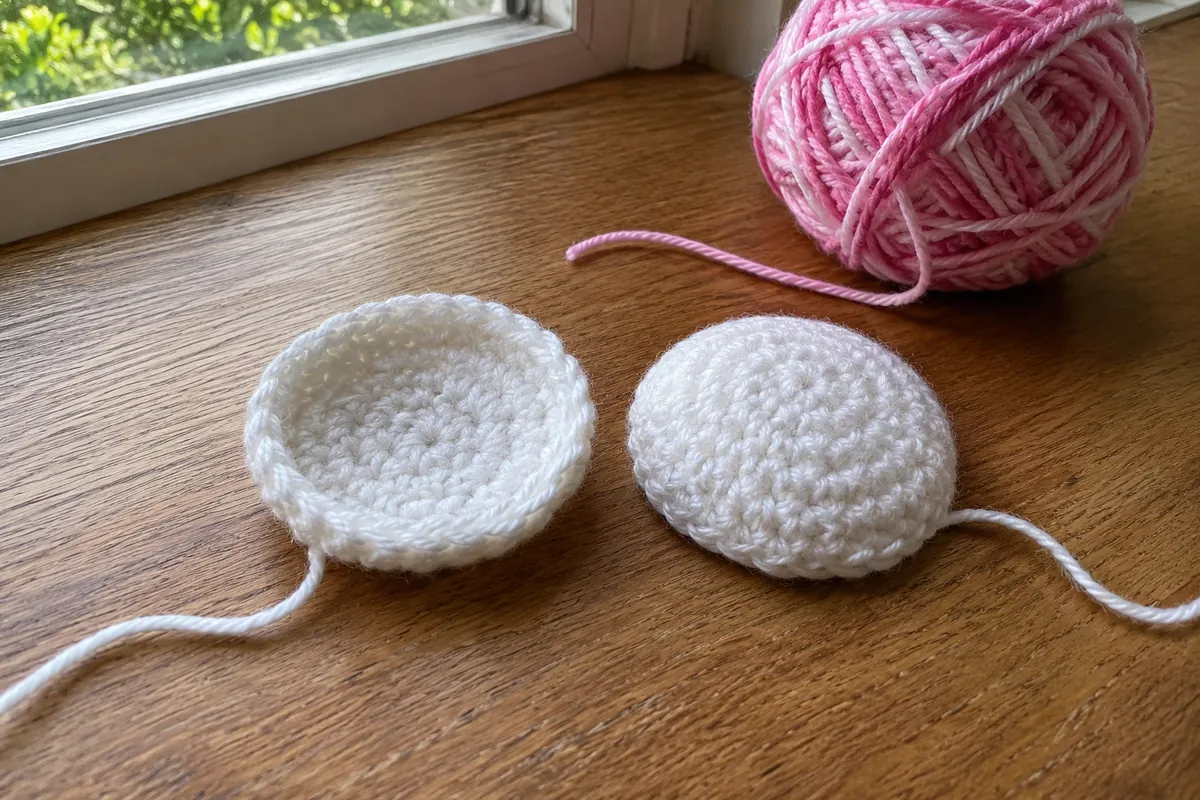
Repeat the complete first-half sequence, from the starting ch 2 through round 5, using MC. Make the second half to the same tension as the first. The supplied instructions do not add an extra round or a different decrease sequence for the lower shell.
Place the halves together before joining and compare their edges. If one contains a missed increase or decrease, correct that crocheting error rather than stretching one edge to fit the other.
 Save
Step 3: join and stuff
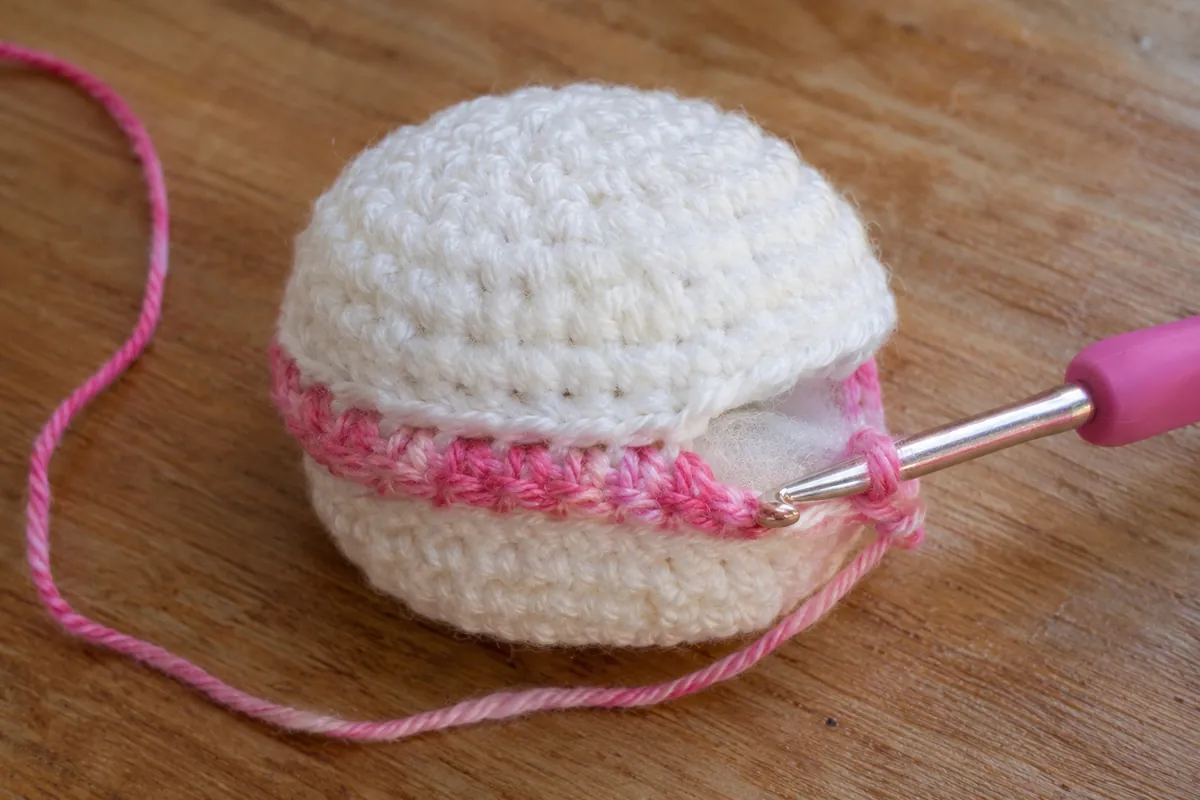
- Hold the first and second halves together. Join A with sl st to any sc of round 5.
- Ch 1. Working in the back loops only of both halves, work 1 sc in each of the next 12 sc.
- Stuff the macaron lightly.
- Work 1 sc in each sc to the end of the round. Join with sl st to the first sc and fasten off.
The contrast round forms the visible filling. Work through the specified back loops of both halves together, keeping their edges aligned. Add the filling at the stated point while the opening is still accessible, rather than attempting to push it through a completed seam.
 Save
Finishing and display
The supplied finishing is the contrast joining round and fastening off; no buttons, beads or embroidered faces are specified. Secure the yarn tails neatly without pulling the seam tight enough to distort the circular shells.
Display the pieces as decorative yarn food. The source does not establish an age rating or toy-safety certification. Keep small stuffed items and any loose yarn ends away from very young children, and follow the yarn and stuffing labels when deciding how to clean them.
Useful questions
Are the two shell halves different?
No. The second half repeats the complete first-half directions in MC.
How many stitches are in each shell's last round?
Round 5 ends with 20 stitches, after the round-4 count of 24 sc.
When is the stuffing added?
After the first 12 joining sc have been worked through the back loops of both halves. Then finish the joining round.
Which yarn makes the filling?
The contrast color A makes the joining round between the main-color shells.
Choose the shell and filling colors, work two matching halves and take your time with the small joining round. For more project updates, follow Pinch of Taste on Facebook and Pinterest.