


Fun Decorations Crochet Pattern: Star, Candy Cane and Flower Garlands
Edited by Nora
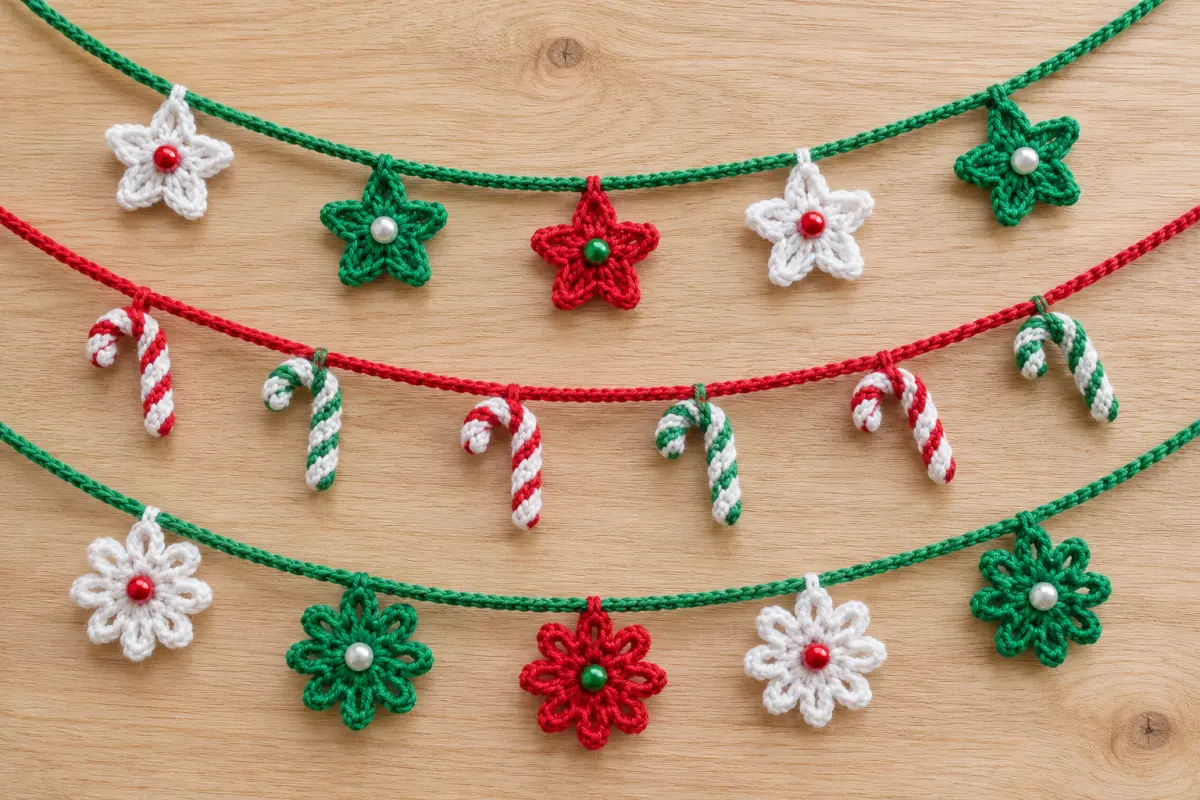
Three small garland designs share a simple idea: make a motif as part of a continuing chain, then repeat the sequence until the strand reaches the length you need. The options are little stars, candy canes and picot flowers. Each has its own chain counts, return stitches and finishing chain, so they are separate instructions rather than interchangeable motifs within one shared repeat.
The source uses US crochet terms. It gives a yarn allowance for an approximate garland length but does not prescribe a fixed number of motifs. The stars and flowers have glued bead centers; the candy canes do not use beads. Keep that distinction clear when gathering the small finishing materials.
 Save
Keep the three instruction sets separate on your work surface. A star's finishing chain does not replace the flower's ending, and the candy cane follows its own return-stitch sequence. Before setting an unfinished strand aside, record which design you chose and the exact point reached within its motif repeat. This simple organization preserves the supplied construction without adding unprinted stitches or an invented fixed motif quantity.
Materials and gauge
- Yarn: the source states that 56.7 g (2 oz) makes a garland approximately 3.5 yd (3.25 m) long.
- U.S. H/8 (5 mm) crochet hook, or size needed to obtain gauge.
- For Garland A or C only: assorted silver, red or white beads, ¼ inch (6 mm) in diameter.
- Hot glue, used for the bead centers in A and C.
Gauge: 14 sc and 16 rows = 4 inches (10 cm). Check your yarn and hook against the stated gauge rather than assuming that every chain-based decoration is size-independent. Tension affects both the size of the motifs and the distance between them.
The source does not name a specific yarn brand, fiber or set of color numbers. Its reference close-ups show red, white and green effects, but those images do not supply a written color-change sequence. The instructions below therefore do not invent a required stripe order or a new measured quantity for each color.
Abbreviations and how to read the repeats
Ch = chain; rep = repeat; sc = single crochet; sl st = slip stitch; sp = space. A marker is used in the candy-cane repeat to identify a previously worked chain. The flower instructions define a picot as ch 2 followed by a sl st in the top of the single crochet just made.
The asterisk marks the start of a repeating group. Complete everything after that asterisk before returning to it for the next motif. The final ch 6, ch 7 or ch 9 is worked only after the garland has reached its required length. It is not added after every star, candy cane or flower.
Read the whole instruction for your chosen design before starting. A short chain immediately after a motif may be part of the next motif's setup. Counting from the hook is especially important because the designs begin their small loops in the fourth or fifth chain, not always in the second chain familiar from many single-crochet patterns.
Garland A: little stars
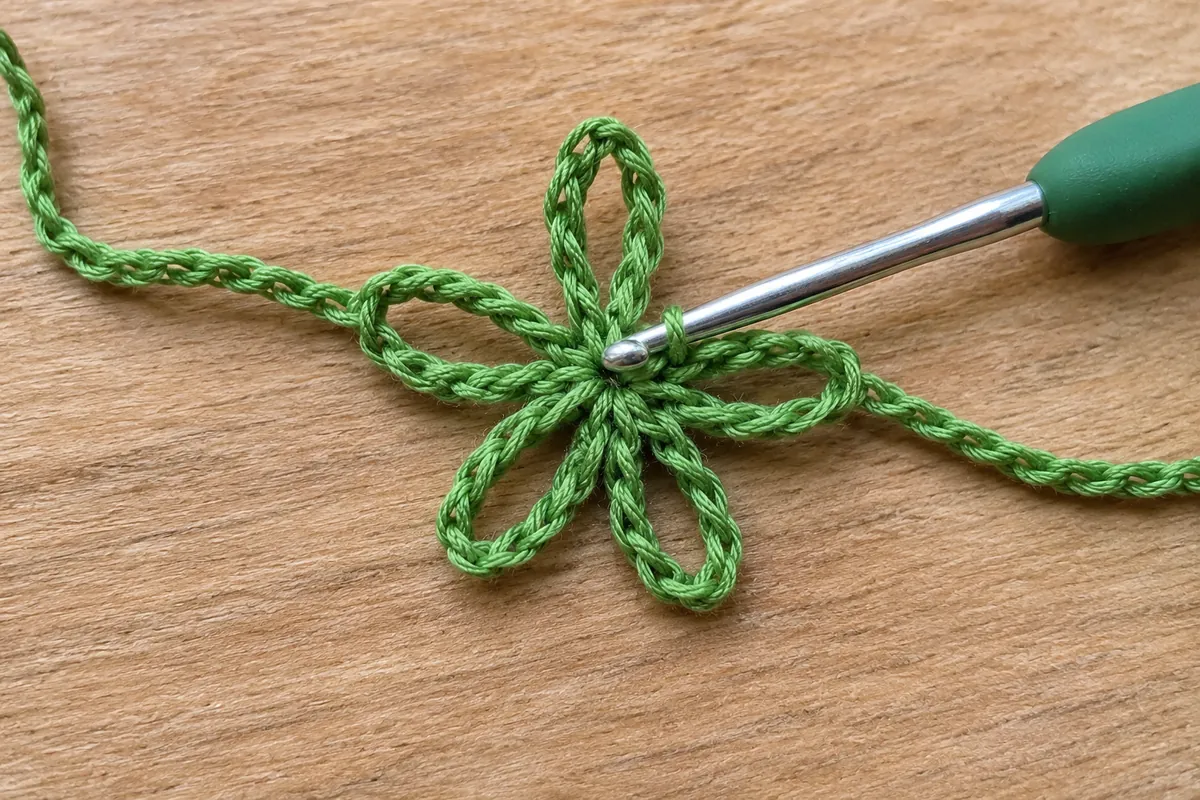
- Begin the repeat: Ch 11. Sl st in the fourth ch from the hook.
- Work (ch 4, sl st in the same space as the last sl st) 4 times.
- Repeat from the beginning of the group until the garland reaches the required length.
- Ch 6. Fasten off.
- Glue a bead in the center of each star.
The repeated slip stitches return to the same space, forming the little looped star around that point. Do not move each return slip stitch into a new chain, because that would spread the loops along a line rather than gathering them into one motif. Identify the central space before beginning the four repeated loop groups.
The initial ch 11 is part of each complete repeat, not just the first star. Keep a running count within the current group rather than trying to count the entire garland at once. If a star has an unexpected number of loops, review that one repeat before continuing to the next section of chain.
Add the bead centers only after the crochet work is complete and the ends are secure. Follow the hot-glue tool's instructions and let the glue cool fully before moving or packing the garland. The source calls for a bead in each star's center; no sewn bead attachment is supplied as an alternative method.
 Save
Garland B: candy canes
- Begin the repeat: Ch 14.
- Work 1 sc in the second ch from the hook and in each of the next 5 ch.
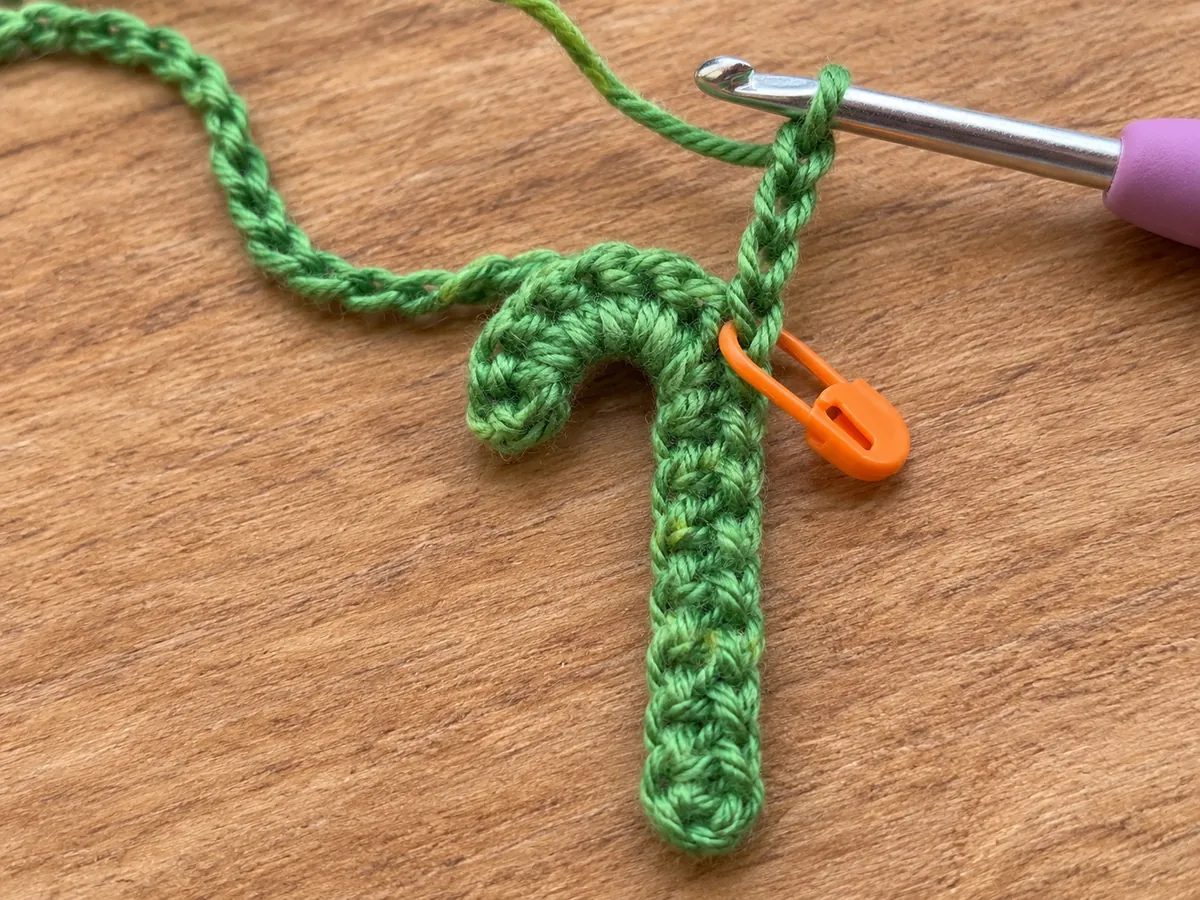
- Work 2 sc in each of the next 2 ch. Place a marker on the last worked chain.
- Ch 4. Work 1 sc in the second ch from the hook, then 2 sc in each of the next 2 ch.
- Ch 1. Sl st in the marked chain.
- Repeat from the beginning of the group until the garland reaches the required length.
- Ch 7. Fasten off.
The marker identifies the chain used to close the small shaping section. Place it in the last worked chain at the point specified, not in the working loop on the hook. Otherwise the later instruction to slip stitch in the marked chain can become difficult to interpret. Move or remove the marker after it has served its purpose.
The increases help curve the candy-cane shape. Work the two single crochet into each named chain rather than distributing them across adjacent chains. Keep the chain visible with your fingers while inserting the hook so that a split strand is not mistaken for a separate chain.
Garland B does not use the bead-center finishing from the other two versions. Do not add glued beads merely because they are included in the shared materials list. Keep the candy-cane repeat intact and finish with the specified ch 7 after reaching the required length.
 Save
Garland C: picot flowers
- Begin the repeat: Ch 15. Sl st in the fifth ch from the hook.
- In the ch-5 ring, work (ch 1, 1 sc, ch 2, sl st in the top of the sc just made) 8 times. Each ch-2-and-slip-stitch section makes a picot.
- Repeat from the beginning of the group until the garland reaches the required length.
- Ch 9. Fasten off.
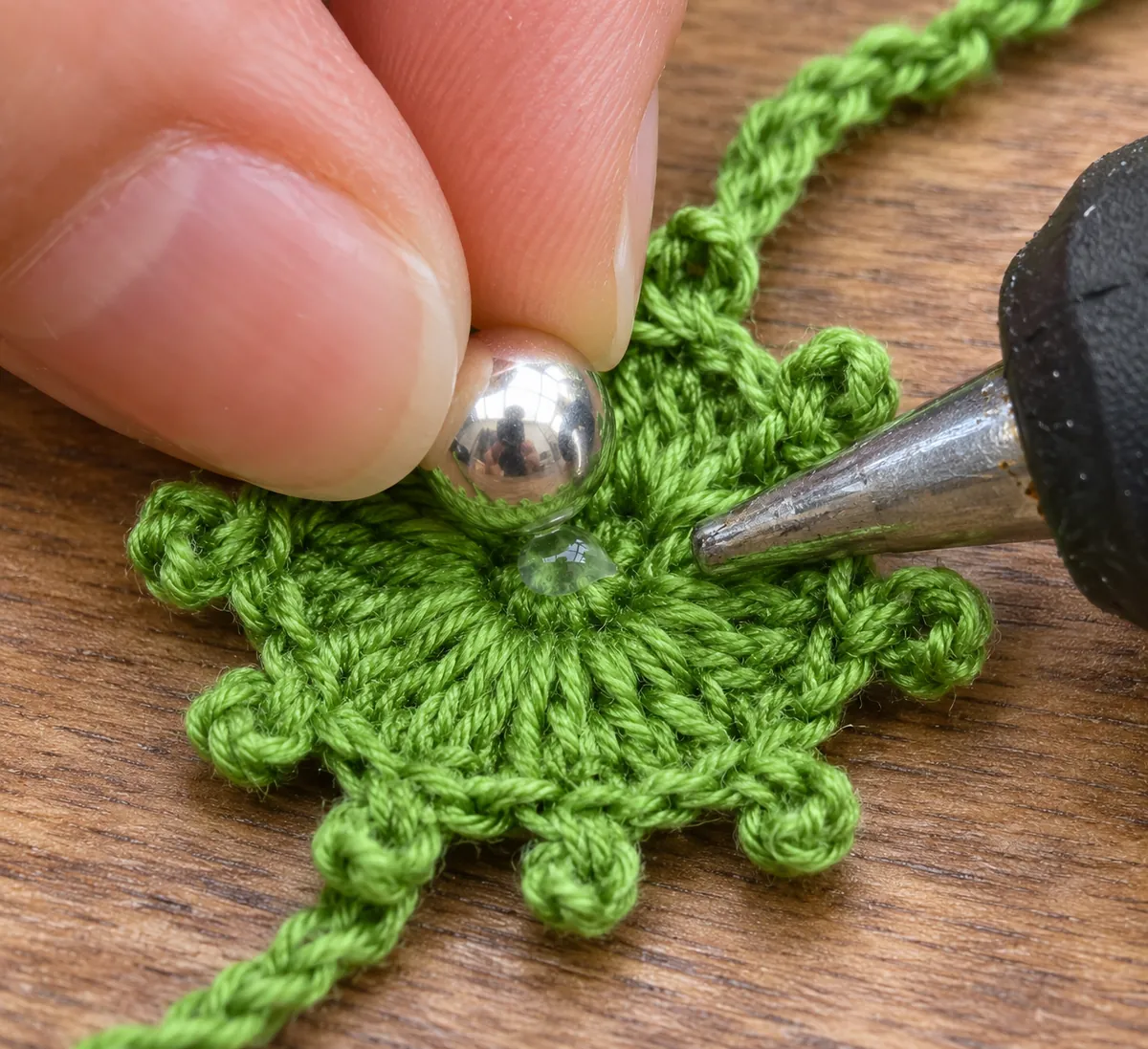
- Glue a bead in the center of each flower.
Keep the ring and the top of the most recently made single crochet distinct. The single crochet is worked into the ring, but the picot's slip stitch returns to the top of that single crochet. Putting every slip stitch into the ring instead would change the small projecting picot edge.
Count eight complete groups around each ring before beginning another ch 15. The whole sequence includes ch 1, the single crochet and the picot. Counting only the visible chain loops can be confusing if they overlap while the flower is still loose on the hook.
Gently spread the completed flower so its picots are visible without stretching the connecting chain. Add the center bead after the crochet has been finished. The source gives the bead diameter, but no glue quantity or curing time, so use the adhesive manufacturer's directions for those details.
 Save
Assembly, display and finishing checks
These strands are crocheted continuously. There is no separate instruction to sew finished motifs onto a purchased cord. Before display, lay the strand on a flat surface and check that it has not twisted around itself. Arrange the motifs naturally along the chain without pulling the spaces longer to imitate a fixed count or length not given in the source.
Weave loose ends into the yarn fabric and remove all temporary markers. For the star and flower versions, inspect the bead centers after the glue has cooled. Small beads and long decorative strands are not suitable for unsupervised child handling. The pattern is not a safety certification or a load-bearing specification.
Keep the garlands away from hot bulbs and open flames. Do not use them to support other objects. Store each strand loosely rather than tying it into a tight knot, especially where bead centers or picots could catch on neighboring motifs. Check the yarn and bead care information before washing or applying heat.
If you set the project aside mid-repeat, write down both the garland letter and the last completed action. “Flower, five groups complete” is more useful than a general round number, because these designs are worked as continuing rows with repeated motifs. Resume from that exact point instead of starting another initial chain within an unfinished motif.
Useful questions
Is a fixed number of motifs required?
No. Each design repeats to the required length. The source gives an approximate yarn-to-length allowance rather than a mandatory motif total.
Do all three versions use beads?
No. The beads and hot-glue center finishing apply to the stars and flowers, A and C, not the candy-cane version B.
Are the three ending chains identical?
No. Finish A with ch 6, B with ch 7 and C with ch 9, then fasten off as directed.
Does the flower have a separate sewn petal?
No. All eight picot groups are worked into the chain ring within the repeating crochet sequence.
Choose one design, track its repeat carefully and finish the small details before hanging the garland. For more projects from Pinch of Taste, visit Facebook and Pinterest.