


Harum Scarum Knit Pants with Narrow Stripes
Edited by Nora
Harum Scarum knit pants have a roomy striped body, narrow ribbed cuffs and an elastic waistband. Each leg begins in the round, increases toward the body and is joined to the other leg on a longer circular needle. A short-row back rise shapes the waist before its ribbed casing is completed. Two small mock drawstrings provide the finishing detail at the front.
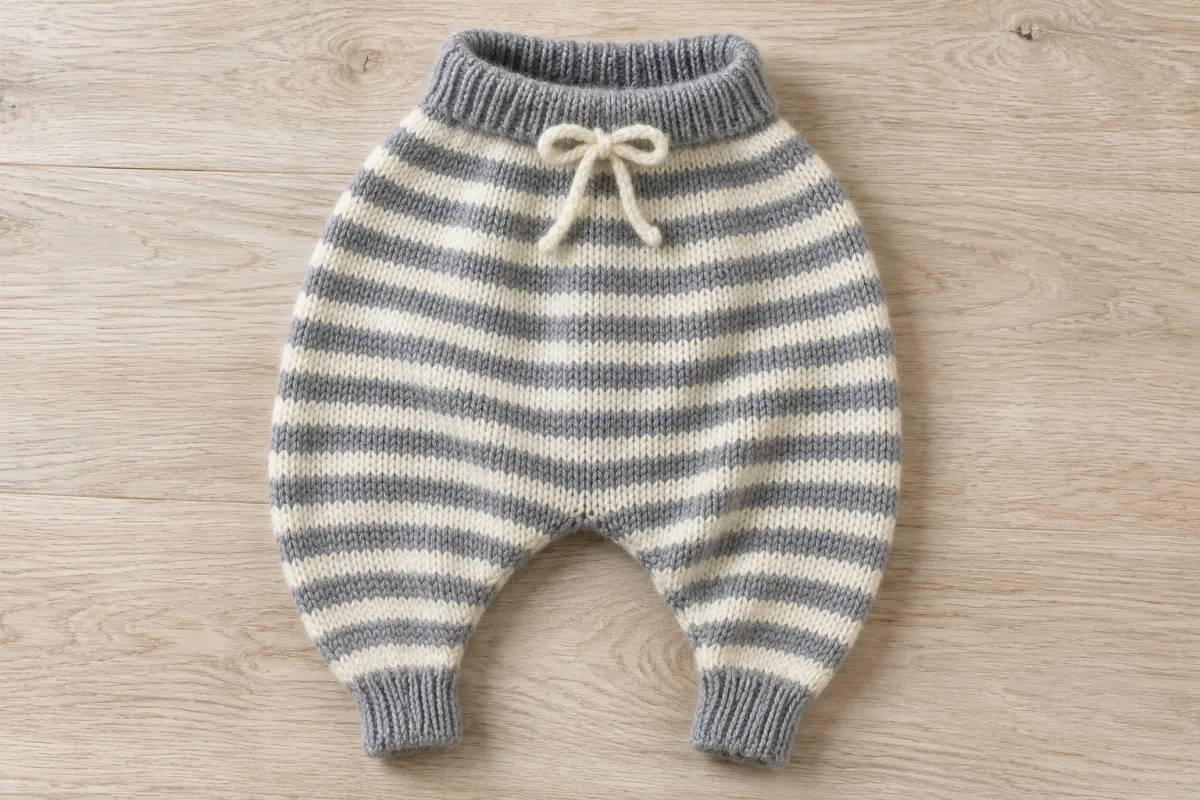 Save
This is an intermediate pattern using US knitting terms. Five sizes are supplied: 6 months, 12 months, 18 months, 2 years and 4 years. Every group of five values below follows that order. The source also labels the two-year waist measurement as 24 months; those refer to the same position in the supplied size sequence.
Measurements and yarn
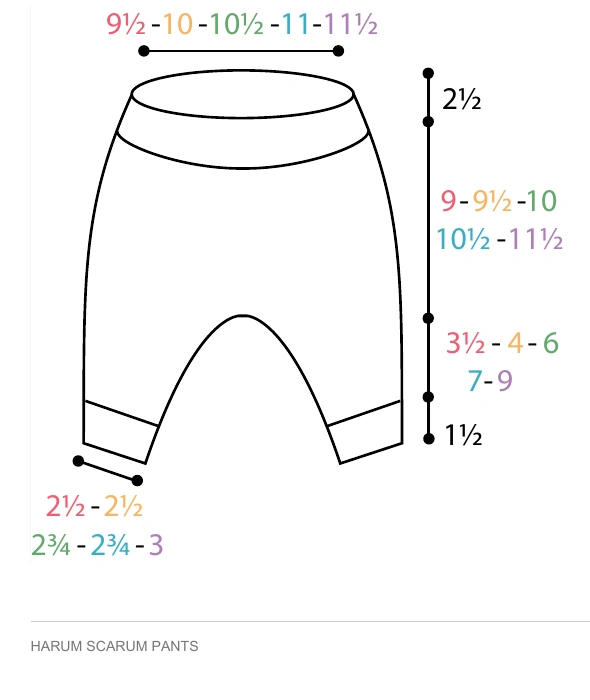
To fit waist measurements: 17 (18-19-20-21) inches [43 (45.5-48-51-53.5) cm]. Finished length from waist to cuff is 16¾ (17¾-20¼-21¾-24¾) inches [42.5 (45-51.5-55-63) cm]. These are separate fit and finished-length measurements, not interchangeable size labels.
- Baby yarn with supplied specification 5 oz/140 g and 362 yds/331 m.
- Contrast A Flannel (30044): 1 (1-1-1-2) balls.
- Contrast B Antique White (30008): 1 (1-1-1-2) balls.
- Sets of four US 5 (3.75 mm) and US 6 (4 mm) double-pointed needles.
- US 5 (3.75 mm) and US 6 (4 mm) circular needles, 16 inches [40 cm] long.
- US 6 (4 mm) circular needle, 24 inches [60 cm] long, or sizes needed for gauge.
- A stitch holder, three stitch markers and 1-inch [2.5 cm] wide elastic to fit the waist.
Gauge is 22 stitches and 28 rows to 4 inches [10 cm] in stocking stitch with the larger needles. Keep both the stitch and row gauge in mind: increases use round counts, while other sections are measured to a stated length. No seam allowance or different finished-length calculation has been added.
Abbreviations and stripe sequence
K means knit; p means purl; beg means beginning; dec means decrease; pat means pattern; PM means place marker; rep means repeat; rem means remaining; rnd means round; st means stitch; tog means together; and WS means wrong side. Kfb increases one stitch by knitting into the front and back of the next stitch. K2tog knits the next two stitches together.
For ssk, slip the next two stitches knitwise one at a time, pass them back to the left needle and knit them together through their back loops. For W&T on a right-side row, bring the yarn forward, slip the next stitch purlwise, bring the yarn back, return the stitch to the left needle and turn. On a wrong-side row, bring the yarn back, slip the next stitch purlwise, bring the yarn forward, return the stitch to the left needle and turn.
The stripe pattern is four rounds with B followed by four rounds with A. Repeat those eight rounds throughout the striped sections. Carry the unused color loosely up the wrong side. The pattern does not require cutting both yarns after every four-round stripe.
Right leg: cuff and initial increases
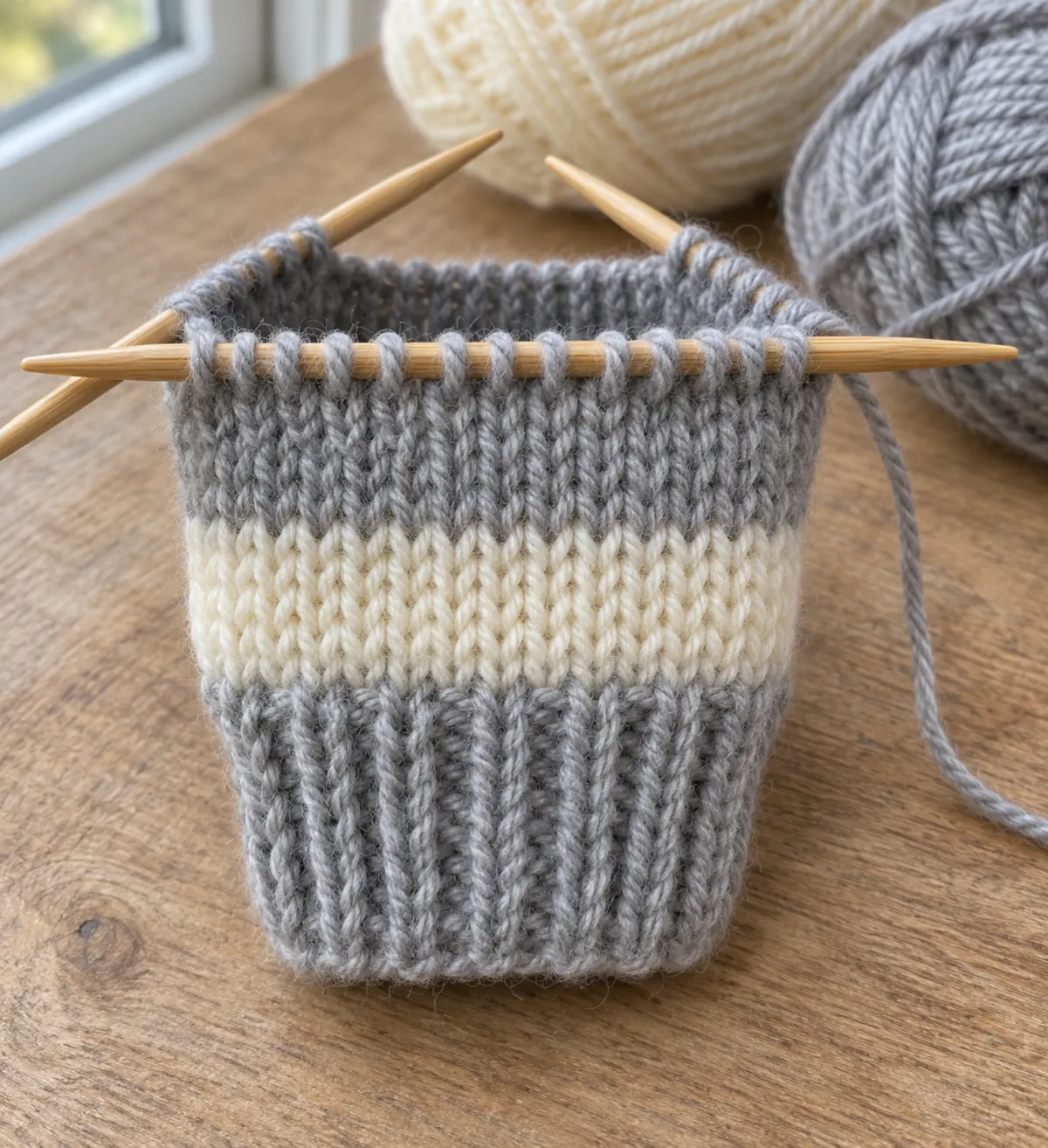
With A and the smaller double-pointed needles, cast on 28 (28-30-30-32) stitches. Divide them onto three needles, join in the round and mark the first stitch. Work (k1, p1) around repeatedly until the cuff measures 1½ inches [4 cm] from the beginning.
Change to the larger double-pointed needles and begin the stripe pattern. For sizes 18 months, 2 years and 4 years only, work 6 (10-14) rounds even in stripes before beginning the following increases. The two smallest sizes do not work those extra initial rounds.
For all sizes, increase Round 1: K1, kfb, knit to the last two stitches, kfb, k1. Round 2: Knit. Repeat those two rounds 1 (3-8-8-19) more time or times. There are 32 (36-48-48-72) stitches. Change to the larger shorter circular needle when necessary as the leg grows.
 Save
Broaden the leg
Next round: work (k1, kfb) twice, knit to the last four stitches, then work (kfb, k1) twice. Knit the following round. Repeat these two rounds 7 (7-10-11-6) more times. There are 64 (68-92-96-100) stitches.
For sizes 6 and 12 months only, work this additional increase round: (k1, kfb) three times, knit to the last six stitches, then (kfb, k1) three times. Knit the following round. Repeat those two rounds twice more, giving 82 (86) stitches. The larger three sizes omit this extra section and retain their preceding stitch totals.
For all sizes, knit even in the stripe pattern until the work measures approximately 5 (5½-7½-8½-10½) inches [12.5 (14-19-21.5-26.5) cm] from the beginning. End with the fourth row of A or B, as the source phrases it. Break B and place all stitches on a holder.
Make the left leg in exactly the same way as the right. Keep the selected size's final stitch total with each leg; the two legs must have matching totals before they are joined. Ending at the specified stripe boundary is separate from reaching the approximate length.
Join the legs and shape the body
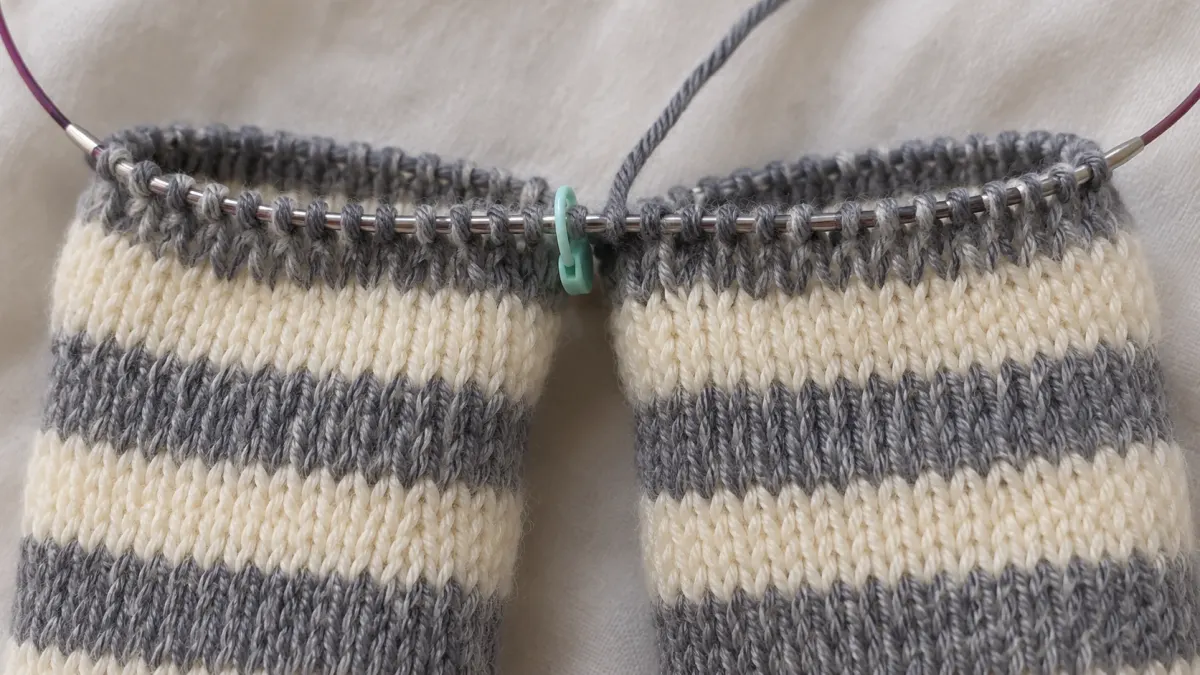
With A and the larger longer circular needle, knit 82 (86-92-96-100) stitches from the right leg and then the same number from the left. Join in the round and mark the first stitch. There are 164 (172-184-192-200) stitches.
Knit 5 (5-5-6-9) rounds even in the stripe pattern. Maintain its sequence during the following shaping, changing to the larger shorter circular needle when needed.
- Shaping Round 1: K38 (40-43-45-47), ssk, k1, place a marker, k1, k2tog; k76 (80-86-90-94), ssk, k1, place a marker, k1, k2tog; knit to the round end. Four stitches are decreased.
- Rounds 2-4: Knit.
- Repeat those four rounds 14 (14-16-17-17) more times. There are 104 (112-116-120-128) stitches.
For sizes 12 months and 4 years only, knit one round while decreasing two stitches evenly around. After that size-specific adjustment, the five-size totals are 104 (110-116-120-126) stitches. The other sizes do not work the two-stitch decrease.
For every size, continue knitting even in stripes until the body measures 9 (9½-10-10½-11½) inches [23 (24-25.5-26.5-29) cm] from the join. This length begins at the leg join, not at the cuff cast-on edge.
 Save
Shape the back waist
- Row 1, RS: K77 (81-86-89-95), W&T and leave the remaining stitches unworked.
- Row 2: P51 (53-57-59-63), W&T and leave the remaining stitches unworked.
- Row 3: K52 (54-58-60-64), W&T and leave the remaining stitches unworked.
- Row 4: P53 (55-59-61-65), W&T and leave the remaining stitches unworked.
- Row 5: K54 (56-60-62-66), W&T and leave the remaining stitches unworked.
- Row 6: P55 (57-61-63-64), W&T and leave the remaining stitches unworked.
- Row 7: Knit to the end of the round. Break B.
Source note: The four-year value in Row 6 is printed as p64, even though the preceding row's four-year value is k66. The printed p64 is preserved, not silently changed to follow an assumed numerical sequence. No additional short-row pickup method has been invented beyond the source's wrap-and-turn directions.
Waistband, elastic and mock drawstrings
Change to the smaller shorter circular needle. With A, work (k1, p1) around repeatedly until the ribbing measures 2½ inches [6 cm]. Cast off in ribbing.
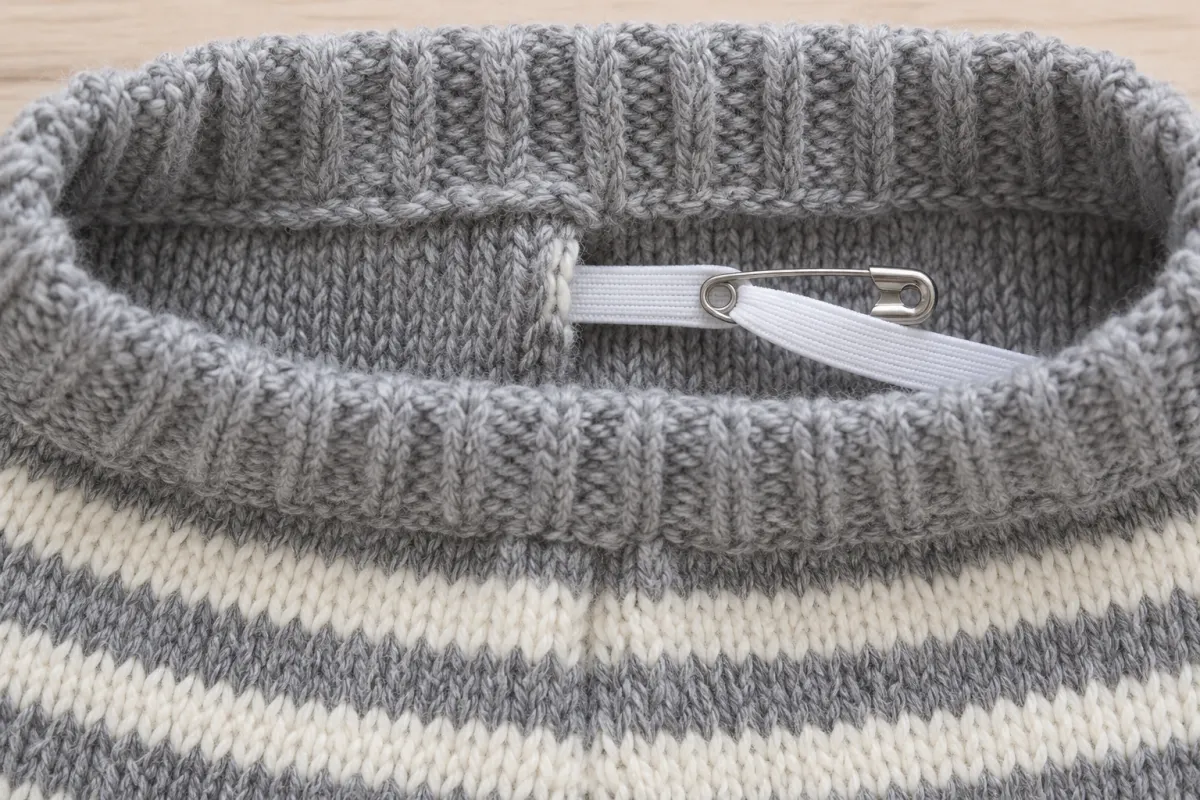
Fold the top edge 1¼ inches [3 cm] toward the wrong side to form a casing. Sew it in place, leaving an opening for the elastic. Cut the elastic to the waist measurement and insert it through the casing. Sew its ends together securely, then sew the opening closed. The source supplies no extra elastic joining allowance in this pattern, so none is substituted from another garment.
For each of two mock drawstrings, use a pair of smaller needles and B to cast on thirty stitches, then cast off. Sew one end of each to the waistband approximately ½ inch [1 cm] to either side of center front, centered vertically in the waistband. These are separate decorative pieces; the actual waist adjustment is the enclosed elastic.
 Save
 Save
Keeping the stripe and shaping records separate
A stripe change is not necessarily the start of a shaping repeat. Keep one note for the four-round color bands and another for the two-round or four-round increase and decrease sequences. That avoids resetting the shaping count whenever the yarn changes. Similarly, retain the marker at the leg join as the starting point for the upper-body measurement, while the cuff cast-on remains the reference for each separate leg. These are tracking practices only; they do not add rounds or change the supplied stitch counts.
Useful questions
Are the legs sewn before joining the body?
No. Both legs are knitted in the round and their live stitches are joined on a circular needle.
Does every size work the same increase sections?
No. The larger three sizes begin with extra even rounds, while only the two smallest sizes work the final six-increase leg section.
Is the drawstring threaded through the waistband?
No. The two mock drawstrings are sewn to the front; elastic runs inside the casing.
Track the four-round stripes alongside the shaping repeats, retain the supplied short-row note and finish the elastic casing securely. Follow our Facebook page and Pinterest page for more project updates.