


Crochet Icicle Ornaments in Two Sizes
Edited by Nora
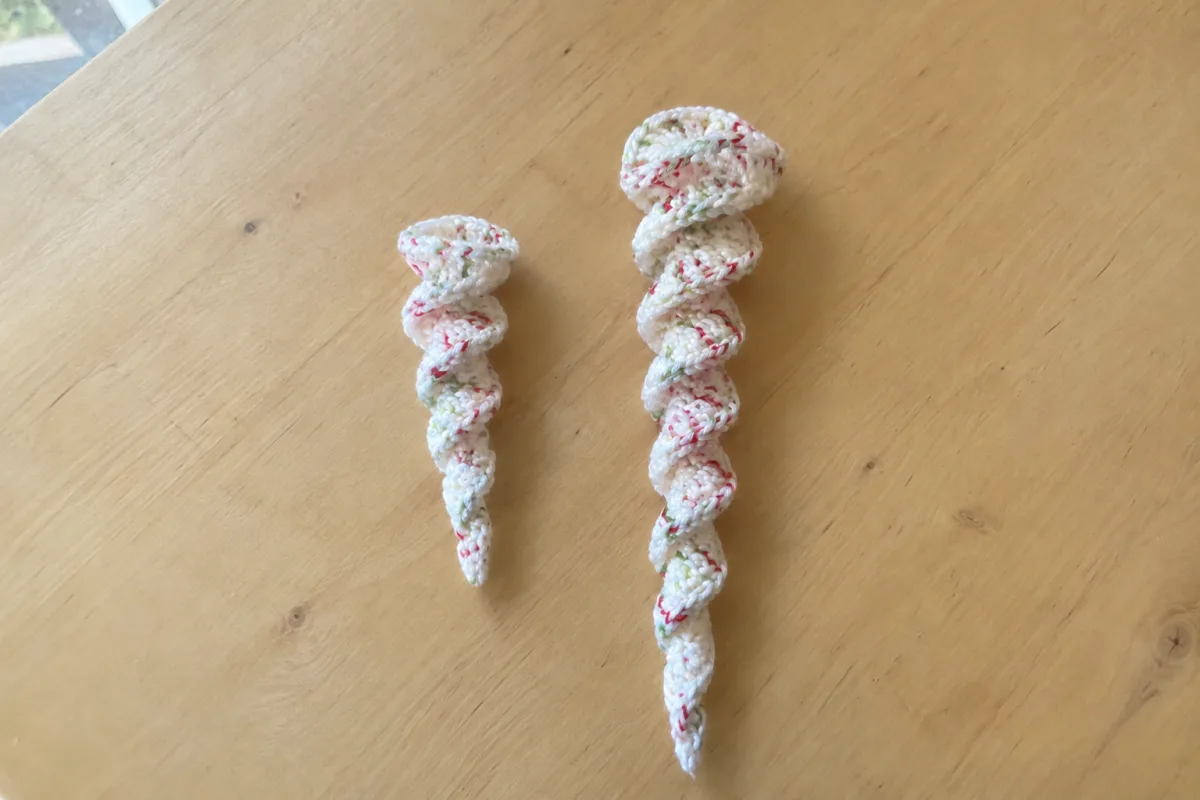
These crochet icicle ornaments turn a single foundation chain into a tapered curl. The stitches become progressively taller and more numerous along the chain, moving from single crochet to half double crochet, double crochet and treble crochet. That changing density gives the strip its corkscrew shape without a separate seam, wire support or stuffed core.
The pattern has two sizes: approximately 5 inches [12.5 cm] and 8 inches [20.5 cm] long. Both use the same order of stitch types, but the longer version has a longer foundation and more chains assigned to the early sections. Choose one size before beginning so that the two sets of numbers do not get mixed in the middle of the row.
 Save
Materials, hook and gauge
- One 100 g/3.5 oz ball of #47005, Holly Jolly Prints.
- 5 mm crochet hook, identified in the source as U.S. H/8, or the size needed to obtain gauge.
Gauge is 13 sc and 14 rows to 4 inches [10 cm]. The source states that one ball makes four small and four large icicles. It does not provide a separate consumed yardage for each ornament, so the ball information and stated yield are retained rather than replaced with a calculated estimate.
The source photograph shows white examples, while the listed yarn shade is Holly Jolly Prints. The written material specification is retained here. Color appearance does not alter the two foundation lengths or the progressive stitch groups that create the spiral.
Abbreviations and stitch preparation
Ch means chain, sc means single crochet, hdc means half double crochet, dc means double crochet and tr means treble crochet. Instructions use U.S. terms. A group such as “3 hdc in each of the next 2 chains” means three complete half double crochet stitches in one chain, followed by three complete half double crochet stitches in the following chain.
The words “in each” are especially important in this pattern. Do not distribute a group's stitch count across the whole section. For example, four double crochet in each chain is not the same as four double crochet divided among four chains. The concentration of stitches in individual foundation chains is what allows the strip to curl.
Single crochet
Insert the hook in the indicated chain, yarn over and draw up a loop. Yarn over and draw through the two loops on the hook. This is the shortest stitch used in the icicle and appears at the narrow starting end.
Half double crochet
Yarn over before inserting the hook, draw up a loop through the indicated chain, then yarn over and draw through all three loops. Complete each stitch before making the next one in the same chain.
Double crochet
Yarn over, insert the hook and draw up a loop. Yarn over and draw through two loops, then yarn over and draw through the remaining two loops. This taller stitch follows the half-double-crochet section.
Treble crochet
Yarn over twice, insert the hook in the indicated chain and draw up a loop. Yarn over and draw through two loops three times. The final section places five treble crochet into every remaining foundation chain, creating the fullest part of the curling strip.
 Save
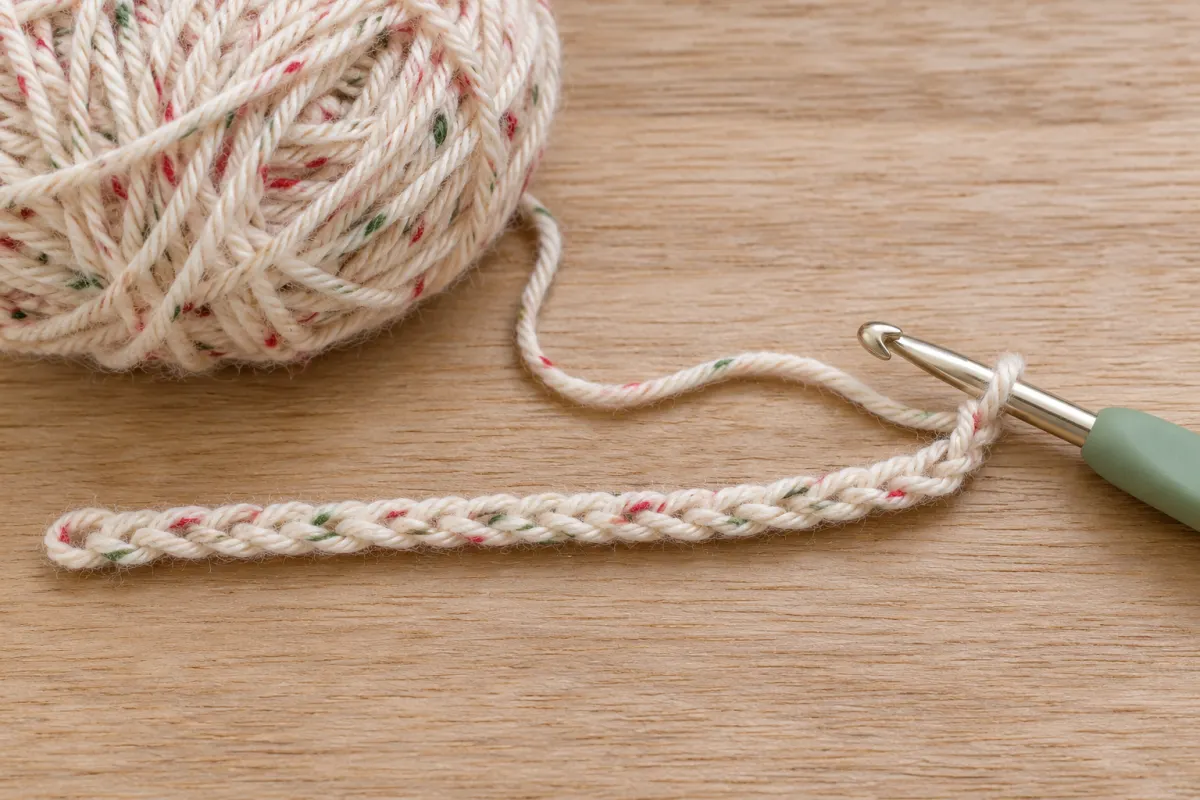
Small icicle: approximately 5 inches [12.5 cm]
- Chain 19 loosely.
- Work 1 sc in the second chain from the hook.
- Work 2 sc in the next chain.
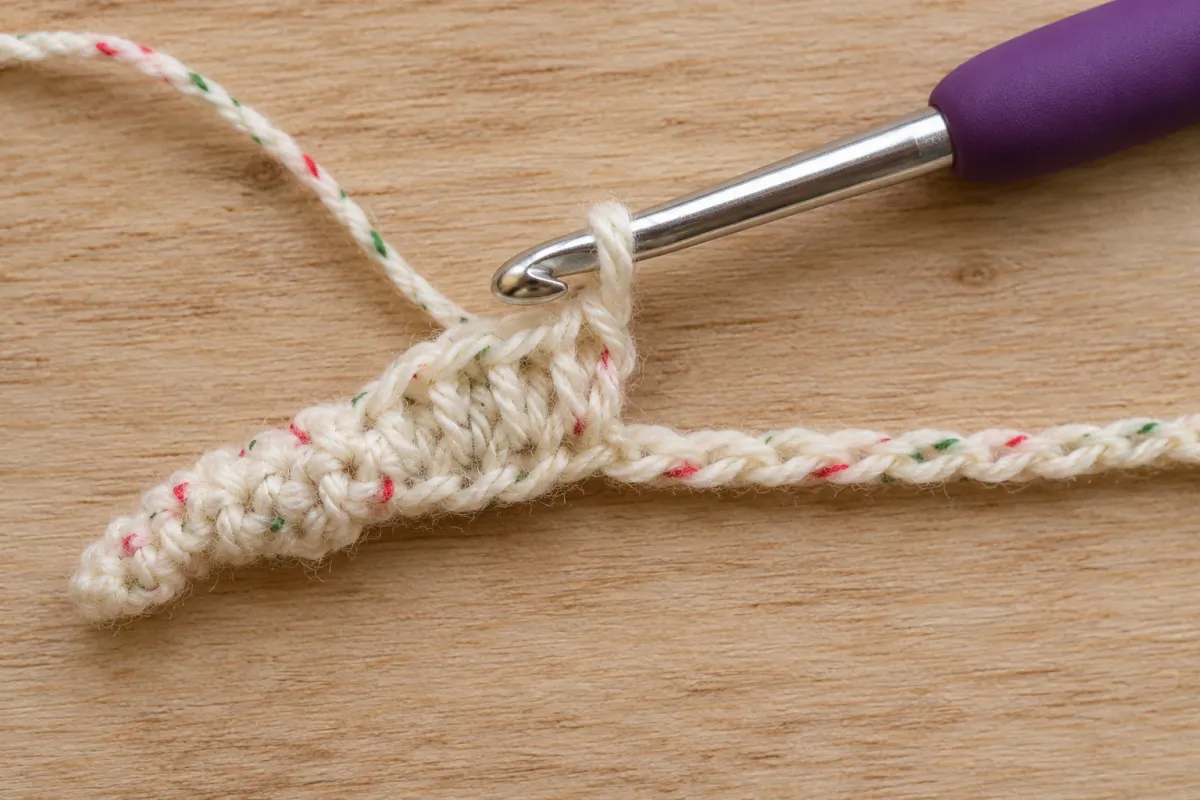
- Work 3 hdc in each of the next 2 chains.
- Work 4 dc in each of the next 4 chains.
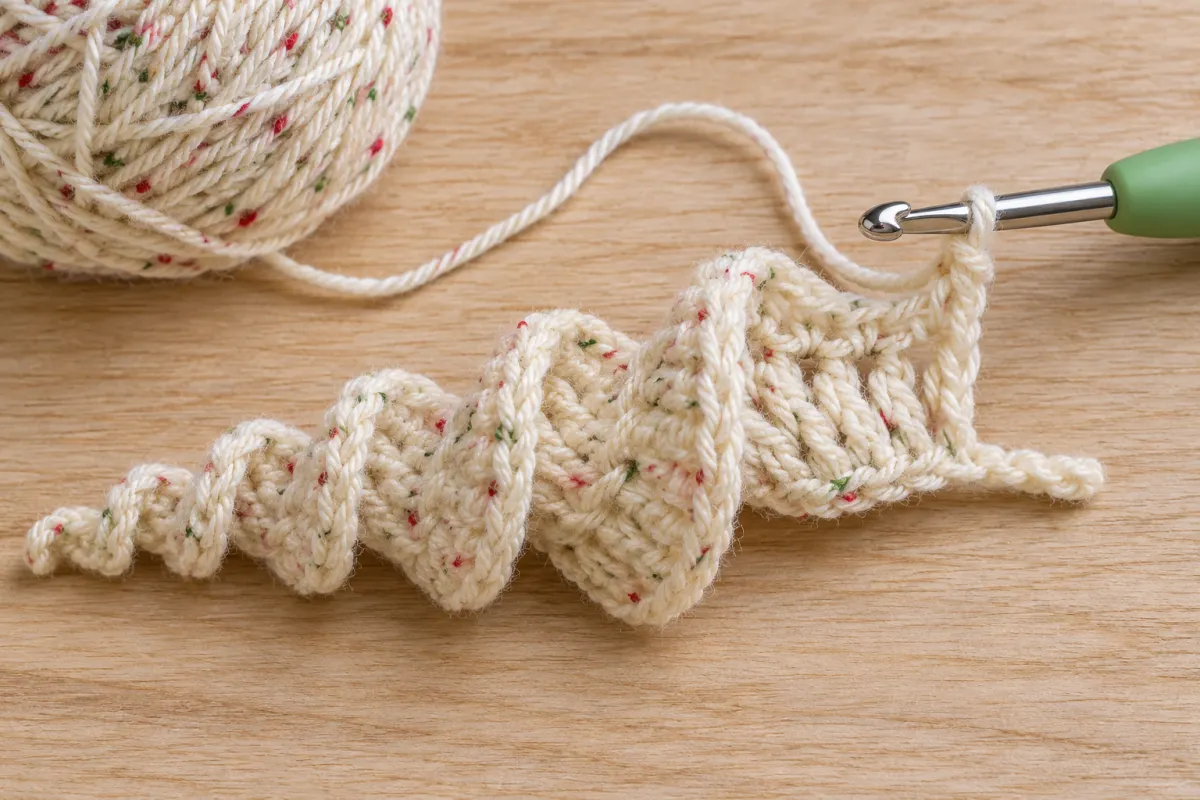
- Work 5 tr in each remaining chain to the end of the foundation.
- Fasten off.
This is the complete small-size technical sequence. It is one worked pass along the foundation, not a set of separate rounds. The source does not add a turning chain and return row after reaching the end.
 Save
Large icicle: approximately 8 inches [20.5 cm]
- Chain 31 loosely.
- Work 1 sc in the second chain from the hook.
- Work 2 sc in each of the next 3 chains.
- Work 3 hdc in each of the next 4 chains.
- Work 4 dc in each of the next 6 chains.
- Work 5 tr in each remaining chain to the end of the foundation.
- Fasten off.
The large size changes the number of chains assigned to the single-, half-double- and double-crochet sections as well as the starting chain. It is not made by using the small instructions on a longer chain and leaving all early counts unchanged.
Follow the taper from short stitches to tall stitches
Read the row as a progression. The single crochet at the beginning starts the narrow end, the next section adds fullness with two stitches in each chain, and the following groups increase both height and density. The final treble section forms the broader end. Keeping those sections in order is more important than trying to arrange a curl before the stitches are complete.
Count the foundation before working into it. Locate the second chain from the hook for the first single crochet, then keep track of the chains used by each following section. It can help to note the current stitch type beside the selected size rather than repeatedly looking between both number sets.
Keep the foundation loose as directed. A tight starting chain can be difficult to enter several times, particularly in the later groups of four or five stitches. Do not compensate by skipping foundation chains or placing fewer stitches into them. Those would change the source's shaping rather than solve an access problem.
 Save
Check the curl without adding construction steps
The strip is meant to curl as many stitches are placed along its foundation. Let it take that form rather than stretching it into a straight band. The source gives no rigid support, stiffener or wire, and none is required by the written construction.
Look along the strip to see where one stitch group changes to the next. An abrupt thin patch may indicate that a group was spread over several chains instead of repeated in each chain. If the shape seems uneven, compare the actual stitch placement to the selected size's sequence before changing the yarn tension or adding stitches.
The stated length is approximate and belongs to the curled ornament. A flat stretched strip will not necessarily resemble that measurement. Gauge is supplied in single crochet, while the actual ornament combines four stitch types. Keep both pieces of source information rather than inventing a separate gauge for each curling section.
Finishing boundaries and handling
The source ends with fastening off. It does not supply a separate hanging-loop chain, ribbon length, sewing instruction or additional edging. The technical sequence is preserved without treating an added loop as an omitted row. If you later choose a display attachment, recognize it as an addition beyond this supplied pattern.
Check the final fastening and any loose working ends before putting the icicle away. Handle the spiral gently rather than pulling it repeatedly to make it longer. The decorative form comes from the worked strip, so stretching it is not a substitute for the longer-size foundation.
Keep a pair consistent
If you make several ornaments from the same ball, label them by size while working. Finish one complete small or large sequence before beginning another foundation. This prevents a chain-19 start from being followed by the chain allocations for the larger version, a combination that is not described in the pattern.
Compare ornaments of the same size in their relaxed curled state. Variegated color placement may differ along the strip even when the stitch sequence is the same, because the source does not instruct you to align color repeats. Do not cut out colors or splice the yarn simply to force identical stripes. Preserve the listed yarn and construction unless you intentionally choose a separate color-placement modification.
Check the chosen size again before fastening off the final treble-crochet group.
Useful questions
How many sizes are included?
Two: approximately 5 inches [12.5 cm] and 8 inches [20.5 cm]. The smaller starts with 19 chains and the larger with 31.
Are these worked in joined rounds?
No. The instructions work along a foundation chain and then fasten off. No joined-round sequence is supplied.
How many treble crochet go into the final chains?
Five treble crochet are worked into each remaining chain, continuing to the end of the foundation. The same final instruction applies to both sizes.
Does one ball make only one icicle?
No. The source says one ball makes four small and four large icicles. No separate per-piece yardage is specified.
Should I sew the spiral into shape?
No sewing step is included. The groups of increasingly tall stitches form the curling strip.
Can I make the large version by stretching the small one?
No. The large version has its own longer foundation and different section lengths. Follow those numbers for the intended larger ornament.
Choose the size, count the loose foundation and work each increasingly full section in order. Explore more craft projects on Facebook and Pinterest.