


Knit Tree Ornaments: Five Textured and Embroidered Designs
Edited by Nora
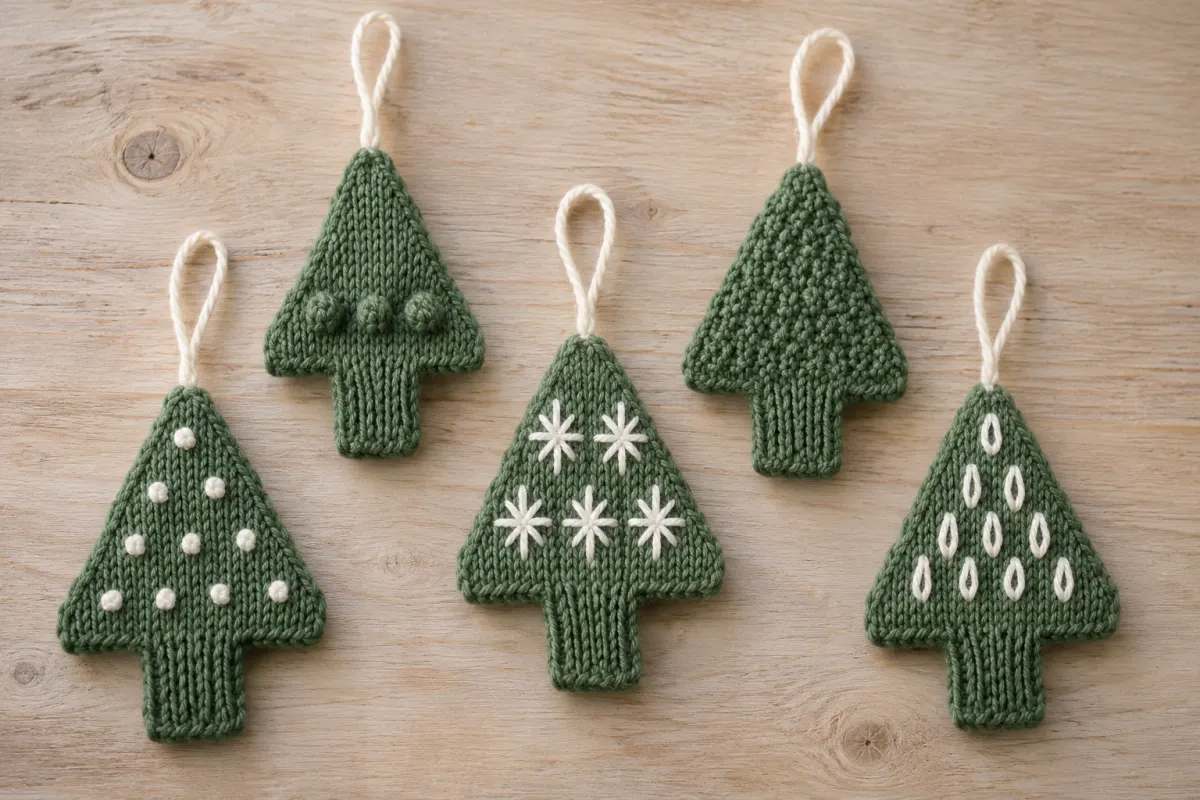
These knit tree ornaments use a small shaped triangle with a ribbed trunk and a white hanging loop. The five-piece collection combines three stocking-stitch trees with different white embroidery, one seed-stitch tree and one tree with knitted green bobbles. The shape is worked in rounds on double-pointed needles, beginning with four cast-on stitches at the top.
 Save
The supplied pattern is rated easy and uses US knitting terms. Each tree measures approximately 5 inches [12.5 cm] tall by 4 inches [10 cm] wide, excluding its hanging loop. Its embedded reference pages contain the plain-tree embroidery directions, which are retained here along with all three knitted versions.
Yarn, needles and gauge
- Medium-weight category 4 yarn, supplied specification 16 oz/454 g and 812 yds/742 m.
- Main Color Hosta (10638): one ball, or 98 yds/89 m for the five ornaments shown.
- Contrast A White (10501): one ball, or 20 yds/18 m for those five ornaments.
- A set of four US 6 (4 mm) double-pointed needles, or the size needed for gauge.
- Stitch markers and a yarn needle.
The source notes that one ball makes forty tree ornaments. The smaller 98-yard main-color quantity is specifically for the pictured five-piece collection; it is not the length of the full ball. Gauge is 20 stitches and 26 rows to 4 inches [10 cm] in stocking stitch.
Abbreviations and the shared beginning
K means knit; p means purl; kfb increases one stitch by knitting into the front and back of the next stitch; PM means place marker; rem means remaining; rep means repeat; rnd means round; and st means stitch. The bobble is worked as [(k1, p1) twice, k1] into the next stitch. Pass the fourth, third, second and first stitches over the fifth, pushing the bobble to the front.
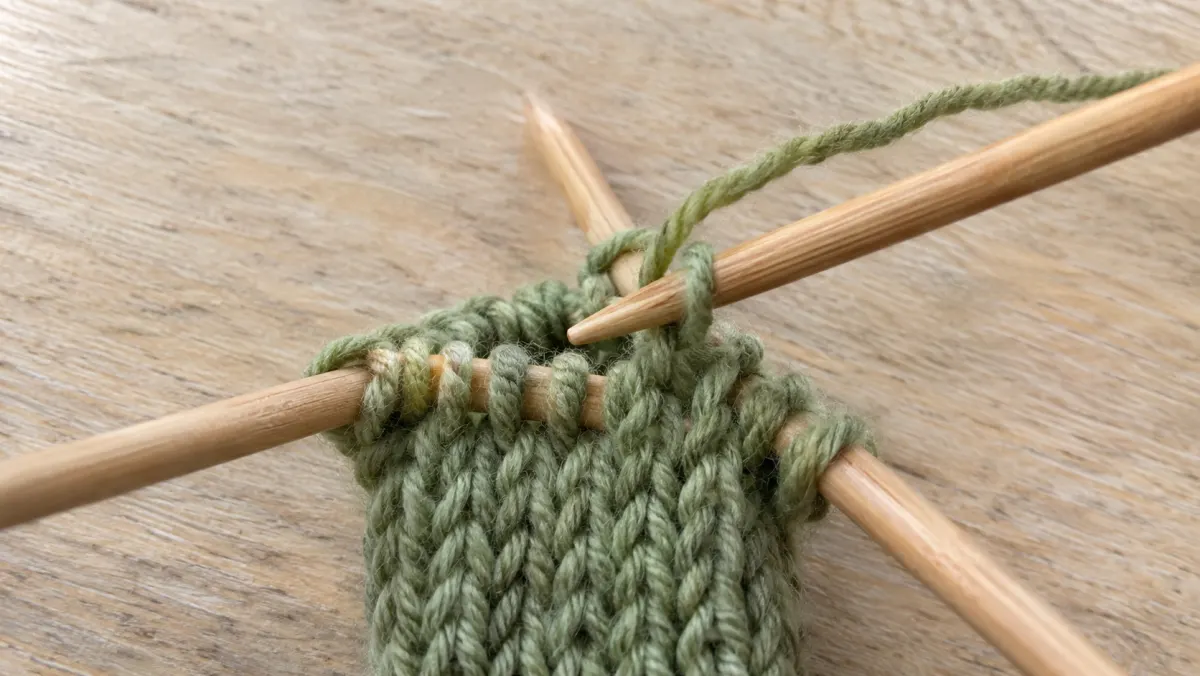
Every version begins with MC and four cast-on stitches. For the first row, work kfb four times, giving eight stitches. Divide them among three needles as two, four and two stitches, then join in the round. Knit Rounds 1 and 2. The initial increase row is separate from those first two rounds and is not counted as Round 1.
 Save
Ornament 1: make three plain trees
- Round 3: K1, kfb twice, k2, kfb twice, k1: twelve stitches.
- Rounds 4-5: Knit.
- Round 6: K2, kfb twice, k4, kfb twice, k2: sixteen stitches.
- Rounds 7-8: Knit.
- Round 9: K3, kfb twice, k6, kfb twice, k3: twenty stitches.
- Rounds 10-11: Knit.
- Round 12: K4, kfb twice, k8, kfb twice, k4: twenty-four stitches.
- Rounds 13-14: Knit.
- Round 15: K5, kfb twice, k10, kfb twice, k5: twenty-eight stitches.
- Rounds 16-17: Knit.
- Round 18: K6, kfb twice, k12, kfb twice, k6: thirty-two stitches.
- Rounds 19-20: Knit.
- Round 21: K7, kfb twice, k14, kfb twice, k7: thirty-six stitches.
- Rounds 22-23: Knit.
The shared trunk
For Trunk Round 1, k4, cast off ten stitches, k8 including the stitch after the cast-off, cast off ten stitches, then k4 including the stitch after the cast-off. Sixteen stitches remain. For Trunk Rounds 2-6, repeat (k1, p1) around. Cast off.
Use that same trunk after each of the other two versions. The two ten-stitch cast-offs form the lower branch edges, leaving the center stitches to form the ribbed trunk. Do not replace the trunk with a separately sewn rectangle.
Three white embroidery treatments
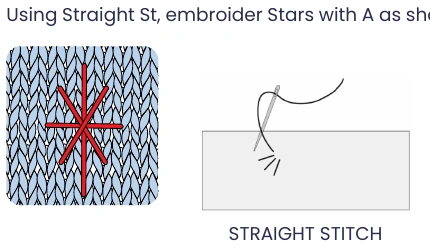
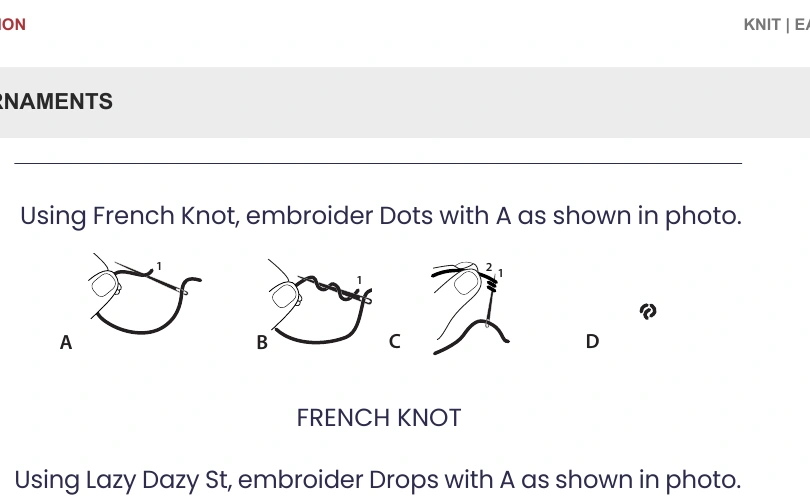
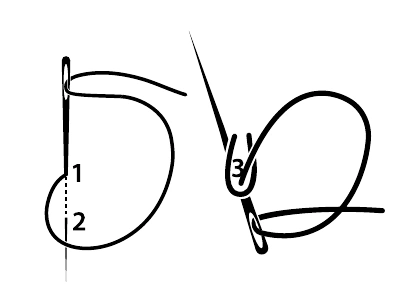
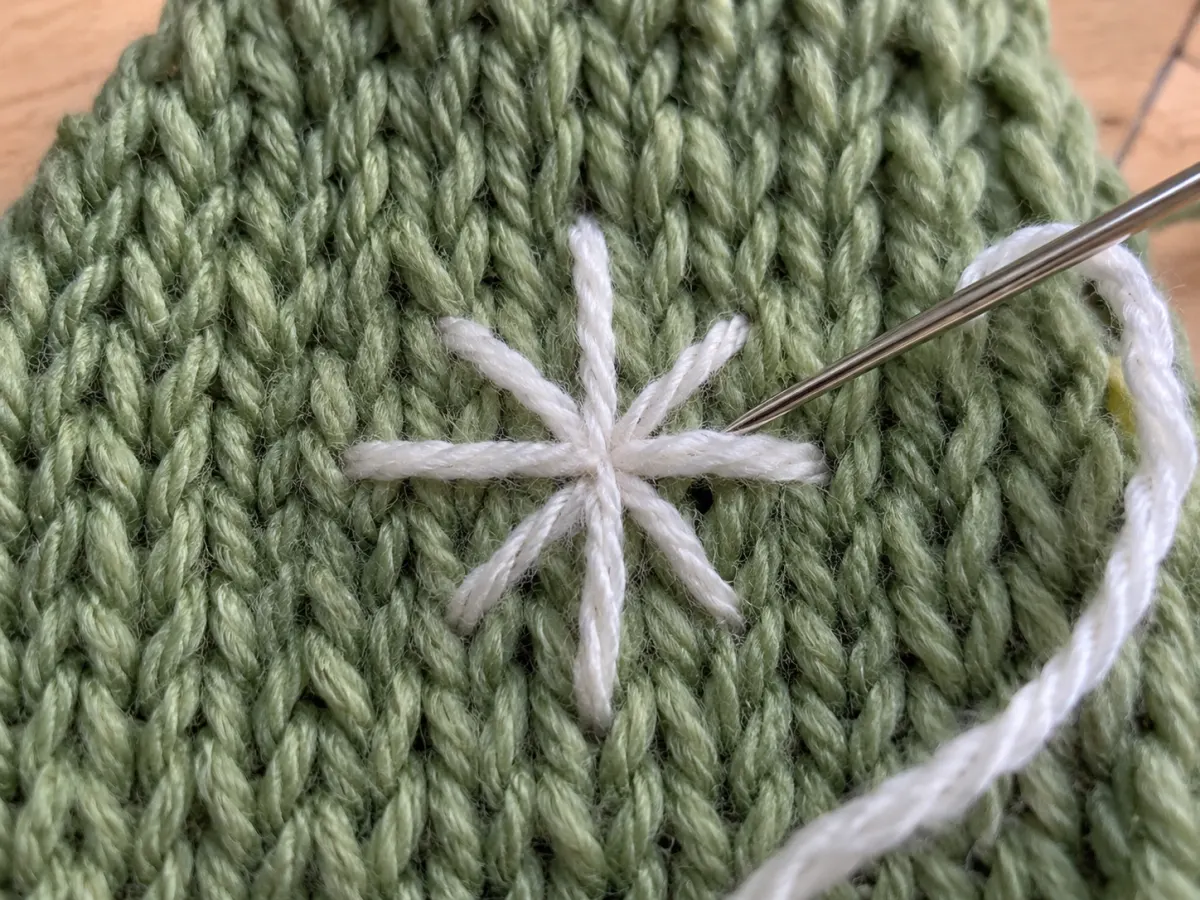
Use A and straight stitch to embroider stars on one plain tree, French knots to embroider dots on another and lazy daisy stitch to embroider drops on the third. Follow the supplied placement references and technique diagrams. These decorations are added after knitting; they are not alternate colorwork instructions for the shaping rounds.
 Save
 Save
 Save
 Save
Ornament 2: one seed-stitch tree
Work the shared cast-on, first increase row and two knit rounds. Continue as follows.
- Round 3: P1, kfb twice, k1, p1, kfb twice, k1: twelve stitches.
- Rounds 4-5: Repeat (p1, k1) around.
- Round 6: K1, p1, kfb twice, (k1, p1) twice, kfb twice, k1, p1: sixteen stitches.
- Rounds 7-8: Repeat (k1, p1) around.
- Round 9: P1, k1, p1, kfb twice, (k1, p1) three times, kfb twice, k1, p1, k1: twenty stitches.
- Rounds 10-11: Work as Round 4.
- Round 12: (K1, p1) twice, kfb twice, (k1, p1) four times, kfb twice, (k1, p1) twice: twenty-four stitches.
- Rounds 13-14: Work as Round 7.
- Round 15: (P1, k1) twice, p1, kfb twice, (k1, p1) five times, kfb twice, (k1, p1) twice, k1: twenty-eight stitches.
- Rounds 16-17: Work as Round 4.
- Round 18: (K1, p1) three times, kfb twice, (k1, p1) six times, kfb twice, (k1, p1) three times: thirty-two stitches.
- Rounds 19-20: Work as Round 7.
- Round 21: (P1, k1) three times, p1, kfb twice, (k1, p1) seven times, kfb twice, (k1, p1) three times, k1: thirty-six stitches.
- Rounds 22-23: Work as Round 4.
Complete the shared six-round trunk and cast off. The alternating plain-round starts are part of this version's texture; a reference to Round 4 means p1, k1 around, while a reference to Round 7 means k1, p1 around.
Ornament 3: one bobble tree
Work the shared cast-on, first increase row and two knit rounds. Use the five-stitch bobble defined above, which returns to one stitch after its passed-over stitches.
- Round 3: K1, kfb twice, bobble, k1, kfb twice, bobble: twelve stitches.
- Rounds 4-5: Knit.
- Round 6: K1, bobble, kfb twice, k3, bobble, kfb twice, k2: sixteen stitches.
- Rounds 7-8: Knit.
- Round 9: K3, kfb twice, bobble, k5, kfb twice, bobble, k2: twenty stitches.
- Rounds 10-11: Knit.
- Round 12: K3, bobble, kfb twice, k7, bobble, kfb twice, k4: twenty-four stitches.
- Rounds 13-14: Knit.
- Round 15: K5, kfb twice, bobble, k9, kfb twice, bobble, k4: twenty-eight stitches.
- Rounds 16-17: Knit.
- Round 18: K5, bobble, kfb twice, k11, bobble, kfb twice, k6: thirty-two stitches.
- Rounds 19-20: Knit.
- Round 21: (K2, bobble) twice, k1, bobble, kfb twice, (bobble, k2) four times, k2, kfb twice, (bobble, k2): thirty-six stitches.
- Rounds 22-23: Knit.
Complete the shared trunk and cast off. The bobbles in this version use MC and belong to the knitted surface; they are different from the white French-knot dots on a plain tree.
Hanging loops and a complete set
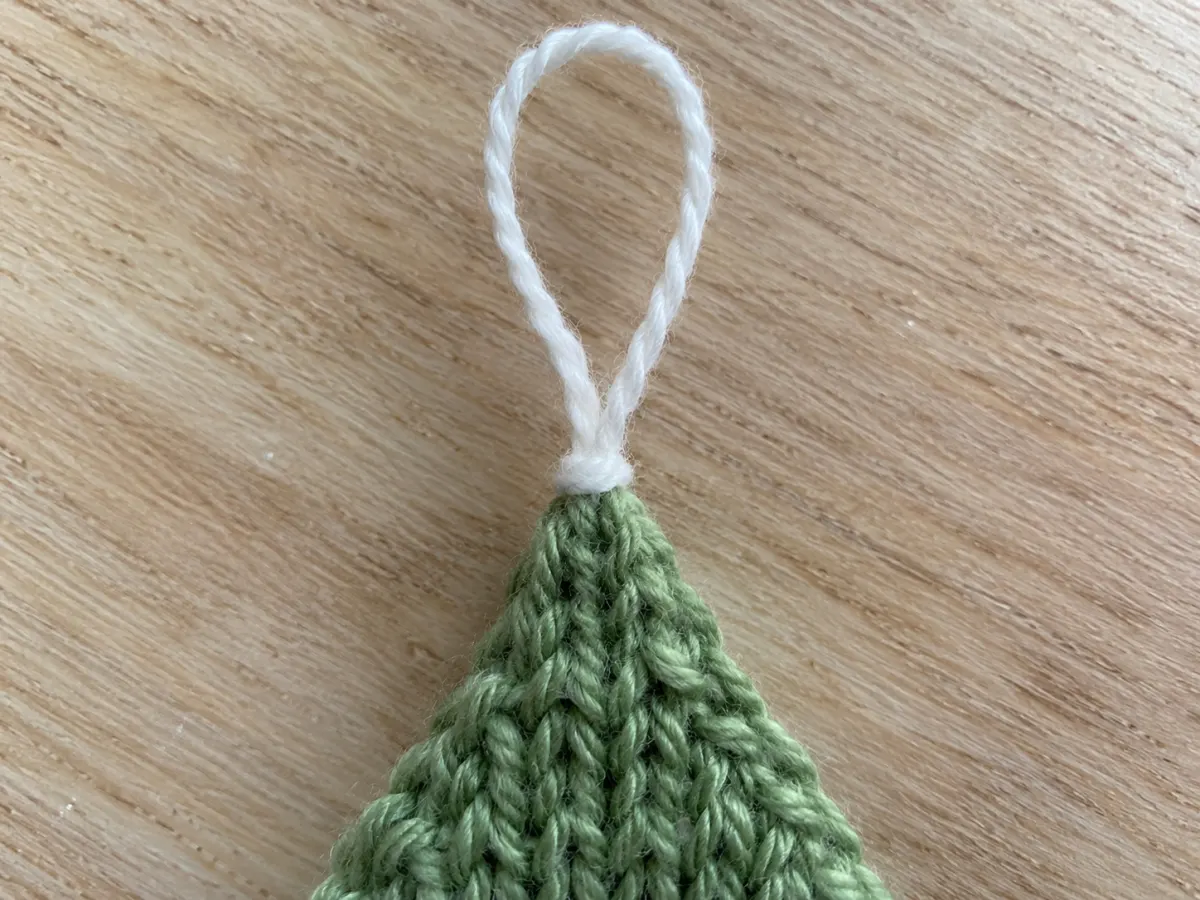
For every tree, cut a 6-inch [15 cm] length of A. Thread it through the top and tie a knot to form the hanging loop. The same loop length applies to all three knitted versions. No stuffing or additional filling material is listed in the supplied instructions.
The collection reaches five trees by making three of Ornament 1, one of Ornament 2 and one of Ornament 3. Keep the embroidery treatment associated with each plain tree when planning the set. It is not necessary to invent two additional shaping patterns to reproduce the five examples.
 Save
Practical tracking notes
Keep the variant number beside the working round number, because all three versions share their increase-round positions but do not share every stitch operation. Counting twelve, sixteen, twenty and later stitch totals checks the shaping, while identifying whether the next plain round begins with knit or purl checks the seed-stitch texture. Those are separate checks.
The trunk's cast-off instructions explicitly count the stitch remaining after each cast-off as part of the next knit group. Retain that qualification when working the sixteen-stitch trunk. It prevents the branch-edge cast-offs from being treated as an unrelated flat bind-off followed by a fresh cast-on.
Reading the embroidery references
The plain knitted tree is the foundation for three distinct embroidered surfaces. A straight-stitch star is built from separate rays meeting around a center. A French knot forms a compact raised dot. A lazy daisy stitch makes an anchored loop, producing the drop-like outline shown on the third plain example. Keep these technique names with the corresponding reference rather than using the word bobble for every raised decoration.
Before embroidering, identify which face of the knitted tree will carry the design and keep the hanging-loop position at the top. The source provides placement photographs rather than a numbered embroidery grid, so no exact new stitch coordinates, knot-wrap counts or thread lengths are introduced here. Use the supplied images as the placement guide while preserving the three separate treatments.
For a set, label the three undecorated plain trees before beginning embroidery: stars, dots and drops. The remaining two trees are distinguished by their knitted texture and do not need white decoration to become different versions. This planning step helps keep the five-piece collection organized without changing any of its shaping or material quantities.
Useful questions
Are there five different knitted shapes?
No. There are three knitted versions; the plain version is made three times and decorated three ways.
Are the white dots knitted bobbles?
No. They are French knots on a plain tree. The separate bobble version uses raised green knitted bobbles.
Does the size include the loop?
No. The approximate 5-by-4-inch measurement excludes the hanging loop.
Choose a version, follow its complete round sequence and finish the matching embroidery or textured surface before attaching the loop. Follow our Facebook page and Pinterest page for more project updates.