


Merry Fair Isle Knit Ornaments: Five Charted Designs
Edited by Nora
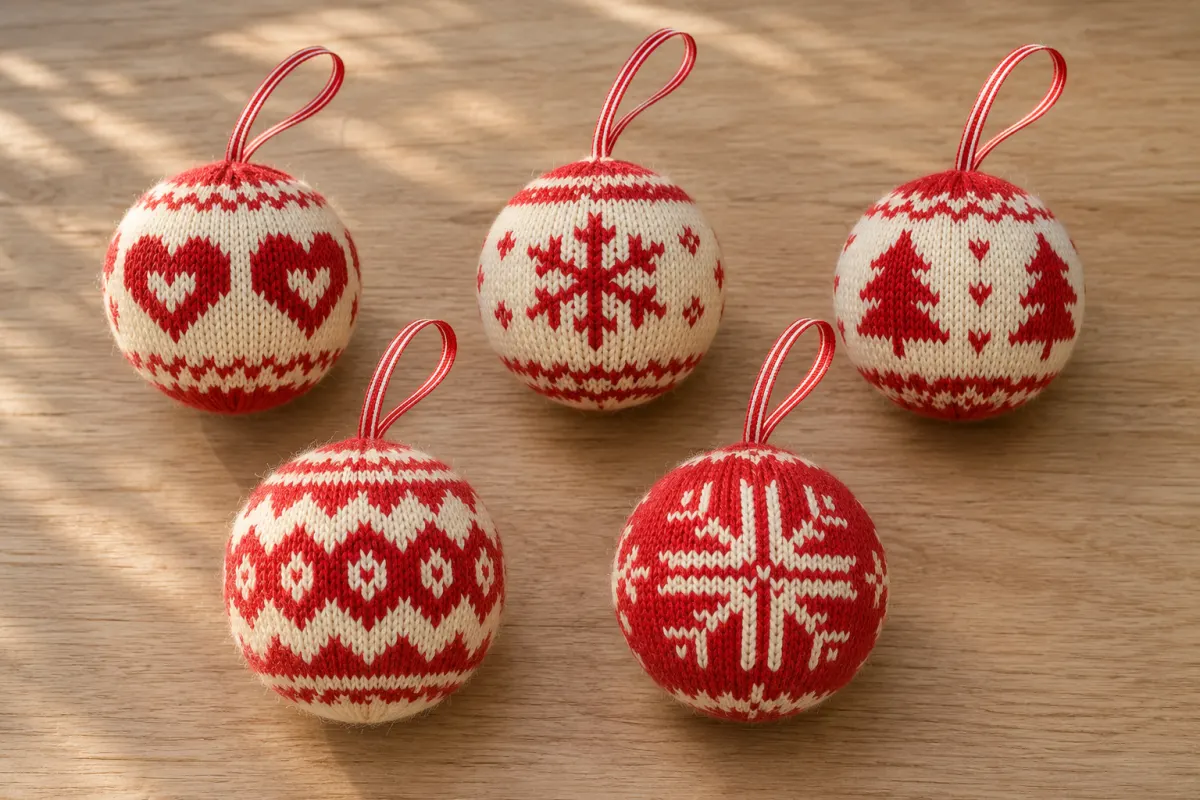
These Merry Fair Isle knit ornaments use one shaped ball pattern with five different colorwork charts. Red and Aran yarn produce hearts, trees and geometric winter motifs, with each chart made once in each color arrangement for ten balls in total. The ornaments are knitted in rounds on double-pointed needles and filled with stuffing, then finished with sewn-on ribbon loops.
 Save
The supplied pattern is intermediate and uses US knitting terms. Finished diameter is approximately 4¼ inches [11 cm]. The color charts are essential instructions, not merely decorative examples: follow the numbered chart row alongside the matching round of the written shaping. This guide preserves the thirty-five-round sequence and all five original chart grids.
Materials for the set
- DK superwash wool yarn, supplied specification 1.75 oz/50 g and 125 yds/114 m.
- Two balls of Red (12705), contrast A, and two balls of Aran (12008), contrast B, to complete the ten-ball set.
- A set of five US 4 (3.5 mm) double-pointed knitting needles, or the size needed to obtain gauge.
- A stitch marker, stuffing and ribbon.
The source notes that one ball each of A and B makes approximately six balls in any design. That smaller-yield note does not replace the two-balls-each list for all ten. The two quantity statements describe different project totals, so keep the intended number of ornaments attached to your supply plan.
No foam insert is specified for these ornaments. Their volume comes from stuffing added at the stated round, and the source cautions against overstuffing. No exact ribbon length is given; it is cut to the desired hanging-loop length during finishing.
Gauge and abbreviations
Gauge is 24 stitches and 30 rows to 4 inches [10 cm] in stocking stitch. The ball is worked in rounds, with its written rounds corresponding to numbered chart rows. Check gauge before relying on the approximate finished diameter, rather than judging size from a photograph.
K means knit; kfb means increase one stitch by knitting into the front and back of the next stitch; k2tog means knit the next two stitches together; rem means remaining; rep means repeat; rnd means round; st means stitch; and WS means wrong side. M1 means pick up the horizontal loop before the next stitch and knit into its back loop to make one stitch.
For the source's ssk, slip the next two stitches knitwise one at a time, pass them back onto the left-hand needle, then knit them together through their back loops. Retain that supplied description when reading the decrease rounds. K2tog and ssk appear on opposite sides of each decrease repeat and are not replaced with a single generic decrease.
Colorwork and chart choice
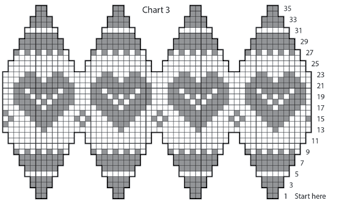
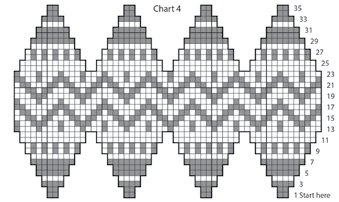
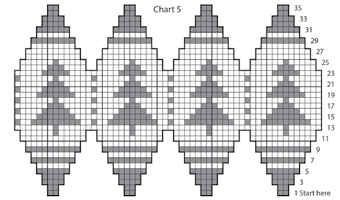
Make one ball from each chart with A as Color 1 and B as Color 2, then one from each chart with B as Color 1 and A as Color 2. That gives five chart choices in two color arrangements. Keep a note of the chosen chart and arrangement so a color reversal does not happen unintentionally partway through a ball.
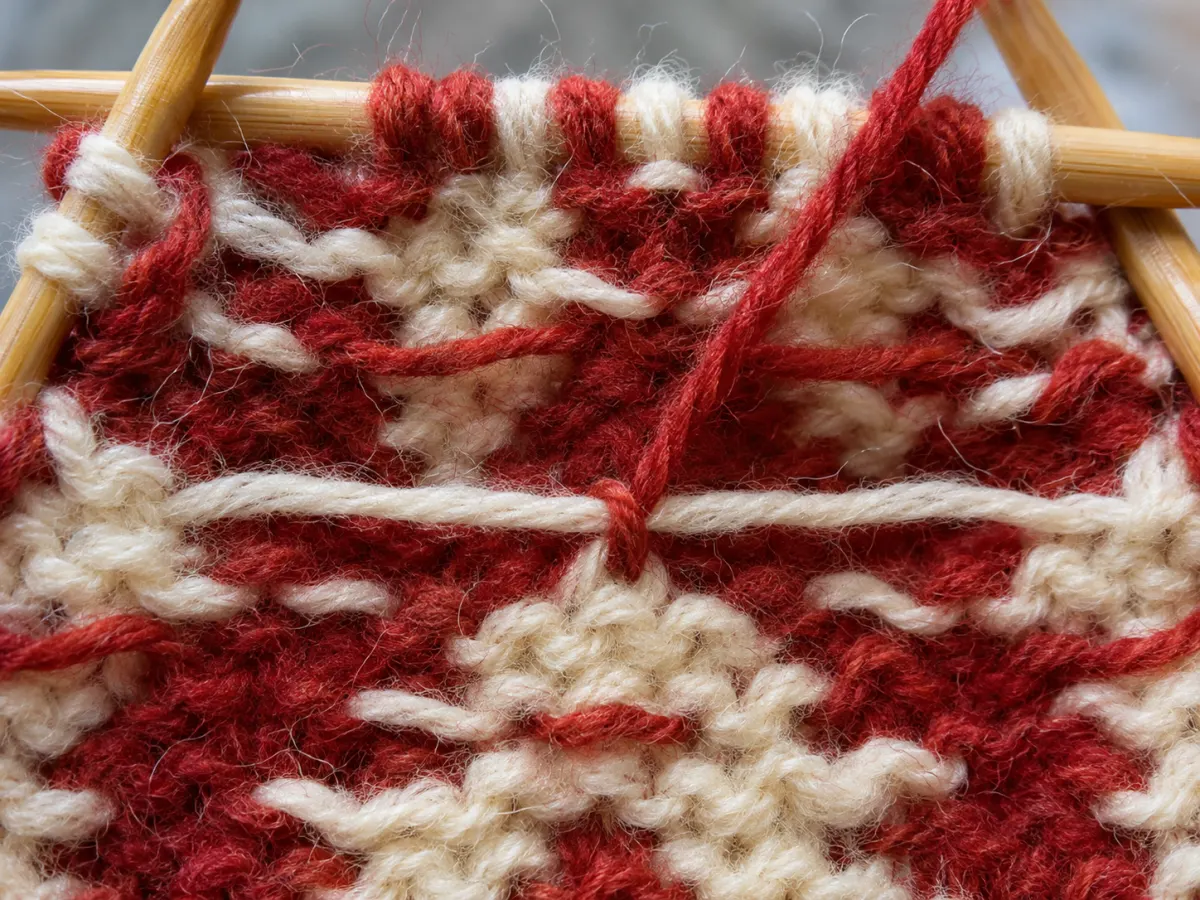
Carry the unused yarn loosely across the wrong side, never across more than five stitches. Where it must cross more than five stitches, weave it over and under the working color at the center point of the stitches it passes behind. The source specifically says the colors are never twisted around one another. These float instructions remain part of the technique even on a small ornament.
The supplied legend text names Color 1 and Color 2, but its extracted presentation does not clearly associate a visible swatch with each label. The unaltered grids are retained below; no new shade-to-label key has been invented. Both color reversals are required by the source set instructions.
 Save
Original colorwork charts
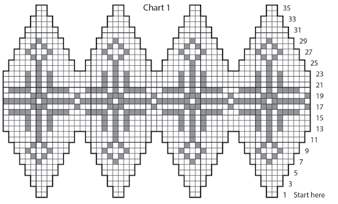
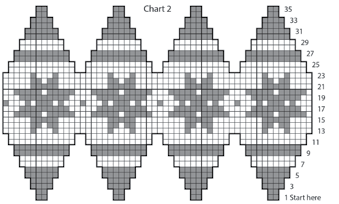
Use the same chart for all thirty-five rounds of an individual ball. Row numbers remain visible on the original grids, including the shaping outline and the marked starting point. These technical chart images preserve the supplied pattern rather than replacing its stitch placement with an approximate motif drawn from the finished photo.
 Save
 Save
 Save
 Save
 Save
Begin and increase the ball
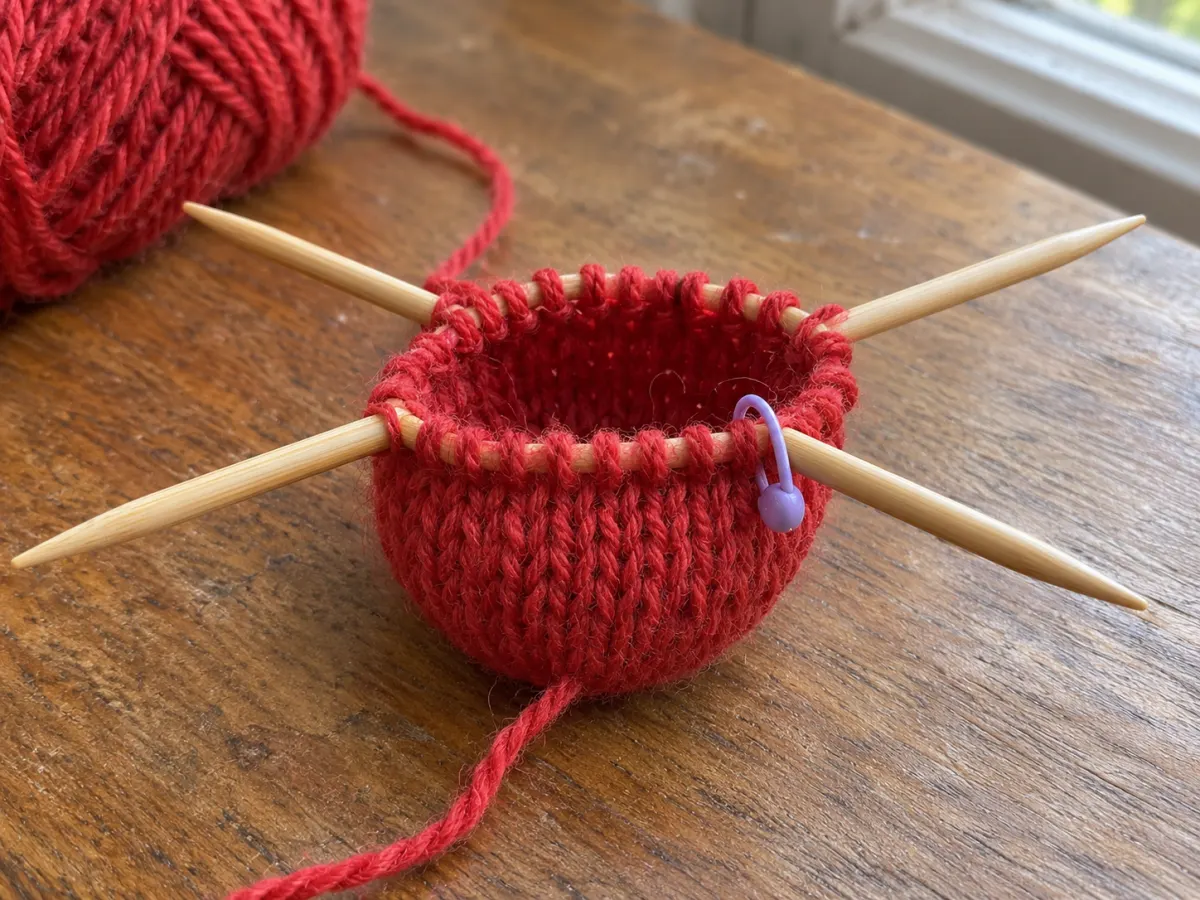
With a pair of double-pointed needles and the color of choice, cast on four stitches. Follow the chosen chart's color placement while working the numbered rounds below.
- Round 1, Chart Row 1: Kfb around, giving eight stitches. Divide them among four needles, join in a round and mark the first stitch. Chart Row 1 is complete.
- Round 2: K8.
- Round 3: Kfb around: 16 stitches.
- Round 4: K16.
- Round 5: *K1, M1, k2, M1, k1; repeat around: 24 stitches.
- Round 6: K24.
- Round 7: *K1, M1, k4, M1, k1; repeat around: 32 stitches.
- Round 8: K32.
- Round 9: *K1, M1, k6, M1, k1; repeat around: 40 stitches.
- Round 10: K40.
- Round 11: *K1, M1, k8, M1, k1; repeat around: 48 stitches.
- Round 12: K48.
- Round 13: *K1, M1, k10, M1, k1; repeat around: 56 stitches.
- Rounds 14-23: K56 on every round, following the corresponding chart rows.
The plain-knit rounds do not mean plain single-color rounds. Their stitch operation is knit, while the chart still determines which yarn color is used for each stitch. Keep the written shaping and the chart color information together throughout the middle section.
 Save
Decrease, block and fill
- Round 24: *K2tog, k10, ssk; repeat around: 48 stitches.
- Round 25: K48.
- Round 26: *K2tog, k8, ssk; repeat around: 40 stitches.
- Round 27: K40.
- Round 28: *K2tog, k6, ssk; repeat around: 32 stitches.
- Round 29: K32.
- Round 30: *K2tog, k4, ssk; repeat around: 24 stitches.
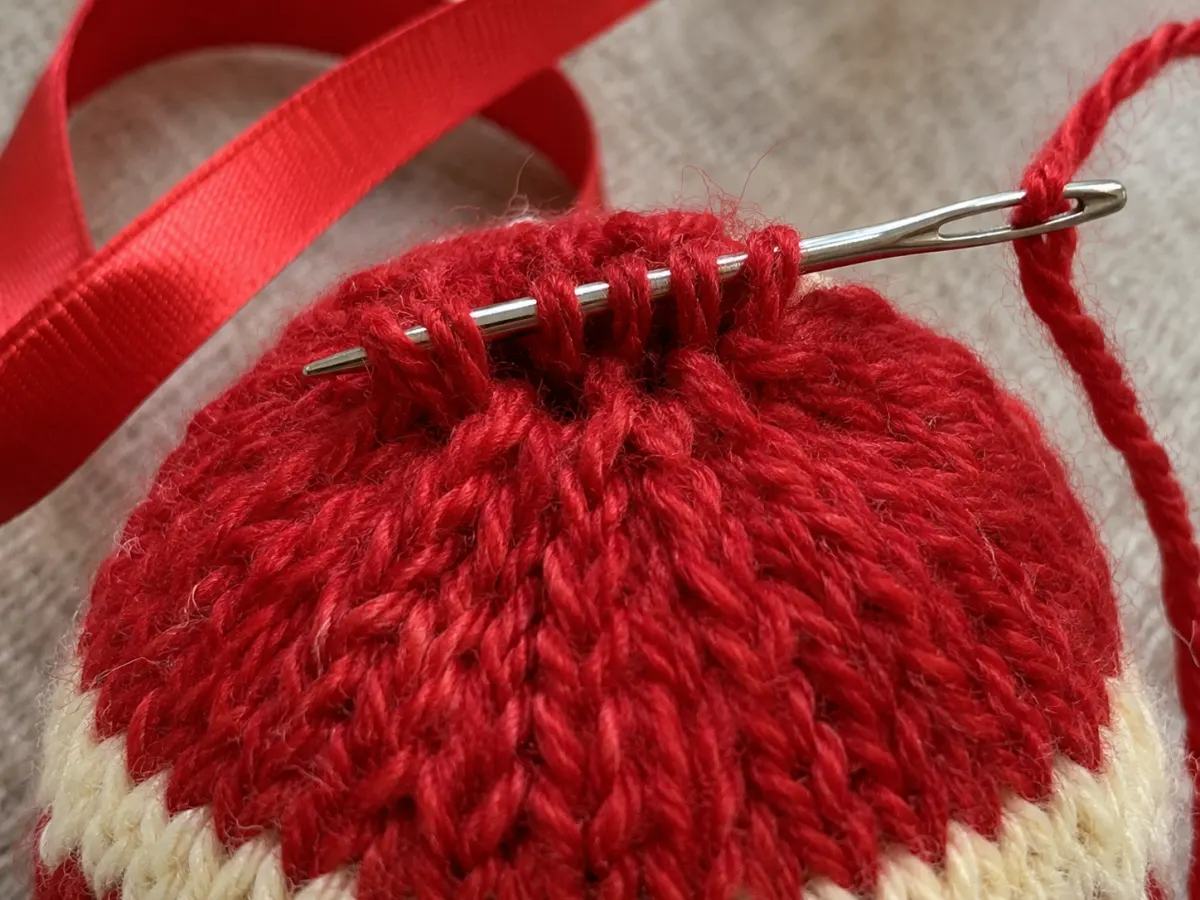
- Round 31: K24. Carefully block the ball while its stitches remain on the needles. Pin to a flat surface, cover with a damp cloth and leave the cloth to dry. Stuff the ball, taking care not to overstuff.
- Round 32: *K2tog, k2, ssk; repeat around: 16 stitches.
- Round 33: K16.
- Round 34: *K2tog, ssk; repeat around: eight stitches.
- Round 35: K8. Break the yarn with a long end. Draw it tightly through the remaining stitches and fasten securely.
The blocking and stuffing directions belong after Round 31, before the final narrowing rounds. They are not moved to the end after the opening has closed. No stuffing weight or precise long-end measurement appears in the source, so those quantities are not invented here.
 Save
Ribbon loop and finished set
Cut ribbon to the desired length, tie it at one end to form a hanging loop, and sew the loop to the top of the ball. The source specifies ribbon rather than an I-cord or crocheted chain for this finishing step. Keep the attachment secure without adding an unprovided closure or metal fitting to the pattern.
Repeat the same shaped ball for each remaining chart and reversed color arrangement. The article's new image shows a selection of the designs, while the written source plan remains ten balls. These are hanging decorations; no testing, personal making experience or toy-safety certification is claimed.
Keeping track of a small colorwork project
Before casting on, write down three things: the chart number, which yarn is Color 1, and which yarn is Color 2. Keep that note with the working yarn rather than relying on the finished-ball photograph. A reversed version of a motif can look quite different even though its stitch positions have not changed. This simple record also makes it easier to assemble the complete ten-ball collection without accidentally repeating the same arrangement twice.
At the end of each increase or decrease round, compare the stitch total with the written number before continuing. The intermediate plain rounds maintain that total; they do not add another increase. If the total differs, identify the place where a repeat was missed before moving to the next chart row. This is a checking practice, not an extra shaping instruction or an adjustment to the supplied pattern.
During finishing, keep the ribbon separate from loose yarn tails so the hanging loop is clearly identifiable. The loop is sewn to the top after the remaining stitches have been drawn closed. Store the matching chart number with any leftover yarn if another ornament will be made later. No additional rounds, ribbon measurements or stuffing quantities are needed to make that record useful.
Useful questions
Do the five charts require five different shaping patterns?
No. Every design uses the same thirty-five-round ball. The chart changes the colors, while the written rounds control the increases, middle section and decreases.
Are the chart rows separate from the round numbers?
They correspond directly. Round 1 completes Chart Row 1, Round 2 follows Chart Row 2, and the relationship continues through Round 35. Do not restart the chart after the first increase section.
When should the stuffing go inside?
After Round 31 and its blocking step, before Round 32 begins. The source specifically cautions against overstuffing.
How does the set reach ten ornaments?
Make all five charts with one Color 1/Color 2 assignment, then repeat all five with those yarn assignments reversed.
Choose one chart, keep its row number beside the written round, and finish the ball before moving to another color arrangement. Find more project updates on our Facebook page and Pinterest page.