


Moonbeam Yoke Crochet Sweater Pattern and Size Guide
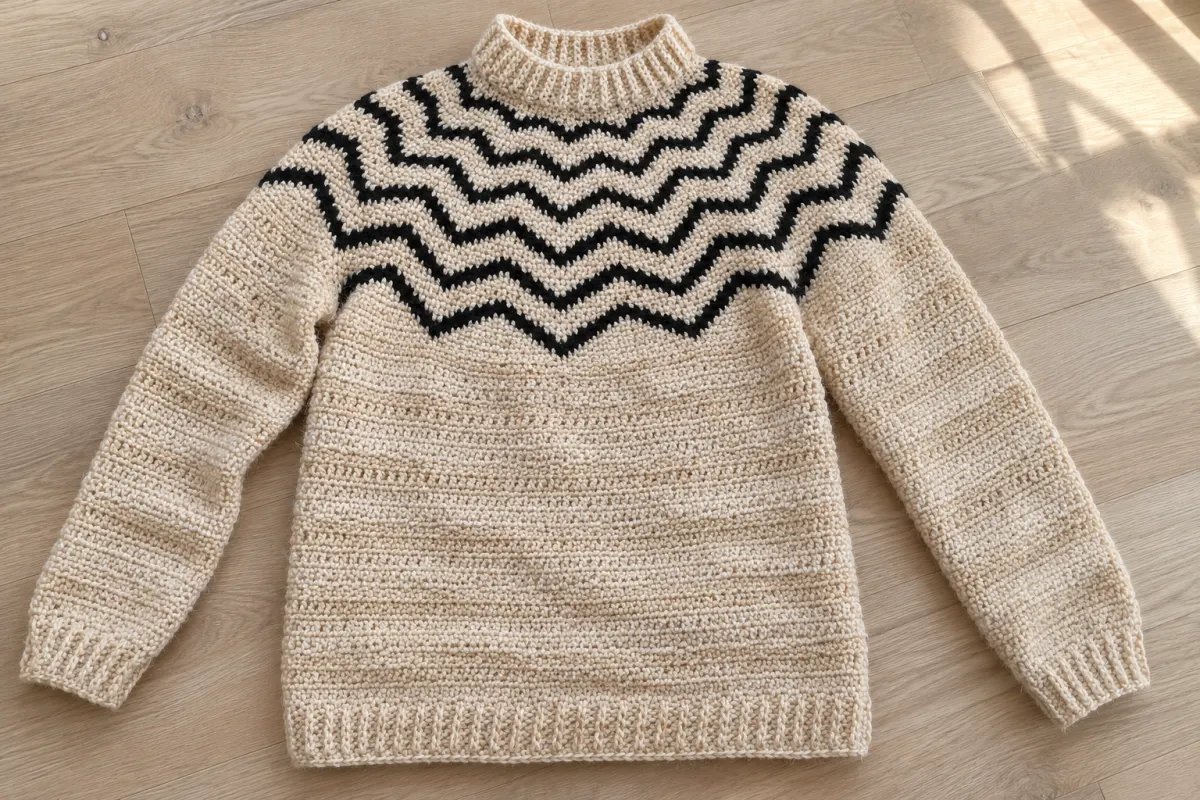
The Moonbeam yoke crochet sweater combines a cream-and-black charted yoke with a textured body and long sleeves. It begins at the neck, grows through the colorwork charts, and then divides into a body and two sleeves. Split single crochet gives the yoke its closely worked surface, while the body changes to alternating single and double crochet. Ribbing at the neckline, lower edge and cuffs frames the finished pullover.
 Save
This intermediate pattern is presented in US crochet terms. All six sizes, chart choices, stitch counts and source measurements are retained below. The supplied PDF contains conflicting numbers in its yarn quantities and yoke measurement line. Those conflicts are identified explicitly; no corrected yardage, row count or garment measurement has been guessed. Read the source notes before buying yarn or relying on a fit measurement.
Sizes and finished chest
Read size sequences throughout in this order: XS/S (M, L, XL, 2/3XL, 4/5XL). A single number applies to every size. The to-fit chest measurement is different from the finished chest measurement, so do not treat the two rows as interchangeable.
| Size | To fit chest | Finished chest |
|---|---|---|
| XS/S | 28–34 inches [71–86.5 cm] | 40 inches [101.5 cm] |
| M | 36–38 inches [91.5–96.5 cm] | 42½ inches [108 cm] |
| L | 40–42 inches [101.5–106.5 cm] | 45½ inches [115.5 cm] |
| XL | 44–46 inches [112–117 cm] | 53 inches [134.5 cm] |
| 2/3XL | 48–54 inches [122–137 cm] | 60 inches [152.5 cm] |
| 4/5XL | 56–62 inches [142–157.5 cm] | 68 inches [173 cm] |
Yarn, hooks and gauge
The main color, MC, is Moonbeam (0102), and contrast A is Black (0312). The supplied ball specification is 7 oz/198 g, 364 yds/333 m, medium-weight category 4. The table retains both the source's ball counts and its printed yardages, even where they do not agree arithmetically.
| Supply | XS/S | M | L | XL | 2/3XL | 4/5XL |
|---|---|---|---|---|---|---|
| MC balls, as printed | 2 | 3 | 3 | 3 | 3 | 4 |
| MC yards, as printed | 1023 | 1120 | 1235 | 1345 | 1460 | 1570 |
| MC meters, as printed | 930 | 1020 | 1123 | 1223 | 1327 | 1427 |
| A balls | 1 | 1 | 1 | 1 | 1 | 1 |
| A yards | 150 | 165 | 185 | 200 | 215 | 235 |
| A meters | 136 | 150 | 168 | 182 | 195 | 215 |
Source quantity note: For example, two 364-yard balls do not total the printed 1023 yards for XS/S. Neither number is silently replaced here. The source also lists MC ball totals for other sizes that are below their stated yardages. Treat this as an unresolved source discrepancy, not a new independently verified shopping calculation.
Use US I/9 (5.5 mm) and US K/10½ (6.5 mm) crochet hooks, or sizes needed to obtain gauge, plus stitch markers and a yarn needle. Gauge with the larger hook is 11½ split single crochet stitches and 13 rows to 4 inches [10 cm]. The body and sleeves use the smaller hook, while the charted yoke uses the larger hook after the neck ribbing.
Abbreviations and special stitches
Alt means alternating; approx means approximately; beg means beginning; ch means chain; cont means continue; dc means double crochet; hdc means half double crochet; pat means pattern; PM means place marker; rep means repeat; rnd means round; RS means right side; sc means single crochet; sl st means slip stitch; st means stitch; WS means wrong side; and yoh means yarn over hook.
Dcfp: Yarn over and draw up a loop around the post of the next stitch at the front of the work, inserting the hook from right to left. Work (yarn over and draw through two loops on hook) twice. One front-post double crochet is made.
Hdc2tog: Work (yarn over and draw up a loop in the next stitch) twice. Yarn over and draw through all loops on the hook.
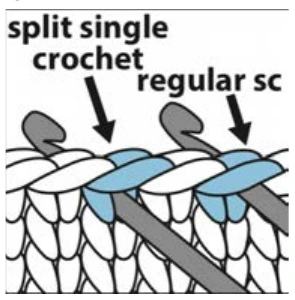
Splsc, split single crochet: Work single crochet between the legs at the front and back of the stitch, splitting the stitch, instead of working through its top loops. The source also uses the spelling “spltsc” in its yoke note; this article treats that as the same named stitch, not a separate technique.
 Save
General notes and chart key
Join every round with a slip stitch to its first stitch or the top of the beginning chain 3. A beginning chain 2 does not count as a stitch. To change color, work to the final two loops on the hook, draw the new color through those loops, and continue, keeping the color change to the wrong side of the work.
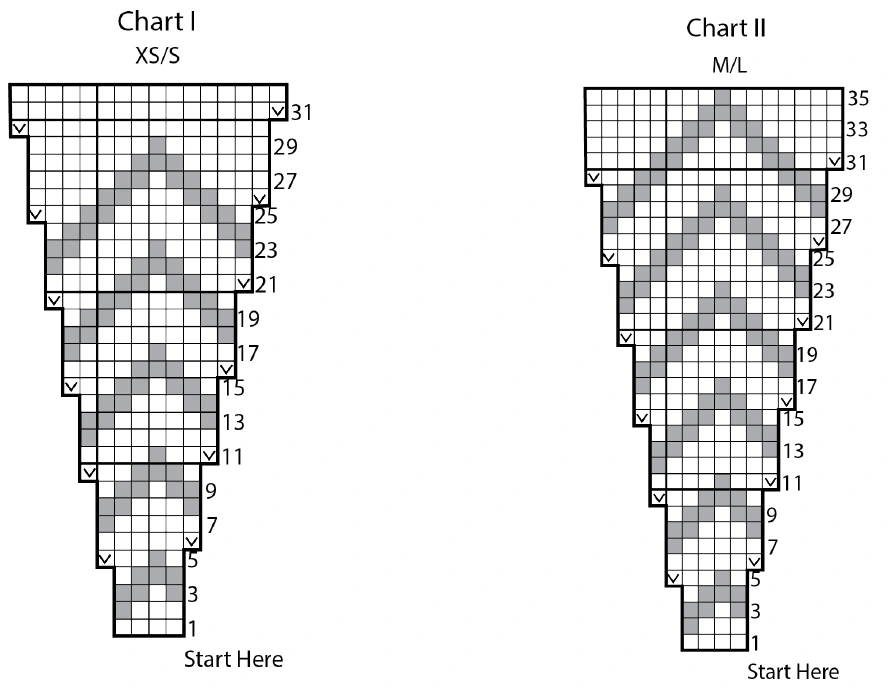
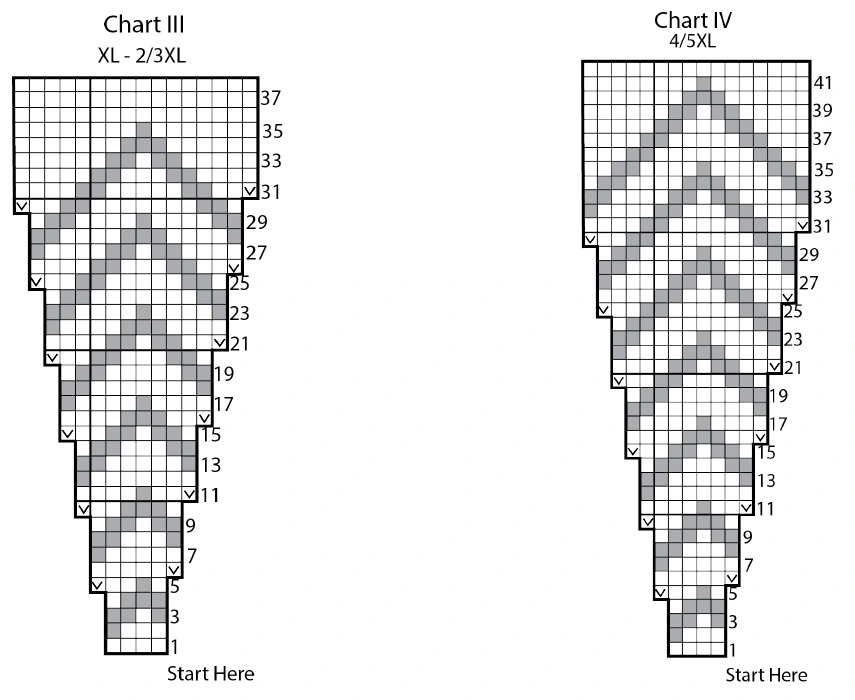
The yoke charts are essential instructions. Read each chart round from right to left. Chart I is for XS/S, Chart II for M and L, Chart III for XL and 2/3XL, and Chart IV for 4/5XL. In the source key, an unshaded square means one splsc in the next sc with MC, a shaded square means one splsc in the next sc with A, and a marked increase square means two splsc in the next sc with MC.
 Save
 Save
Begin the neck and charted yoke
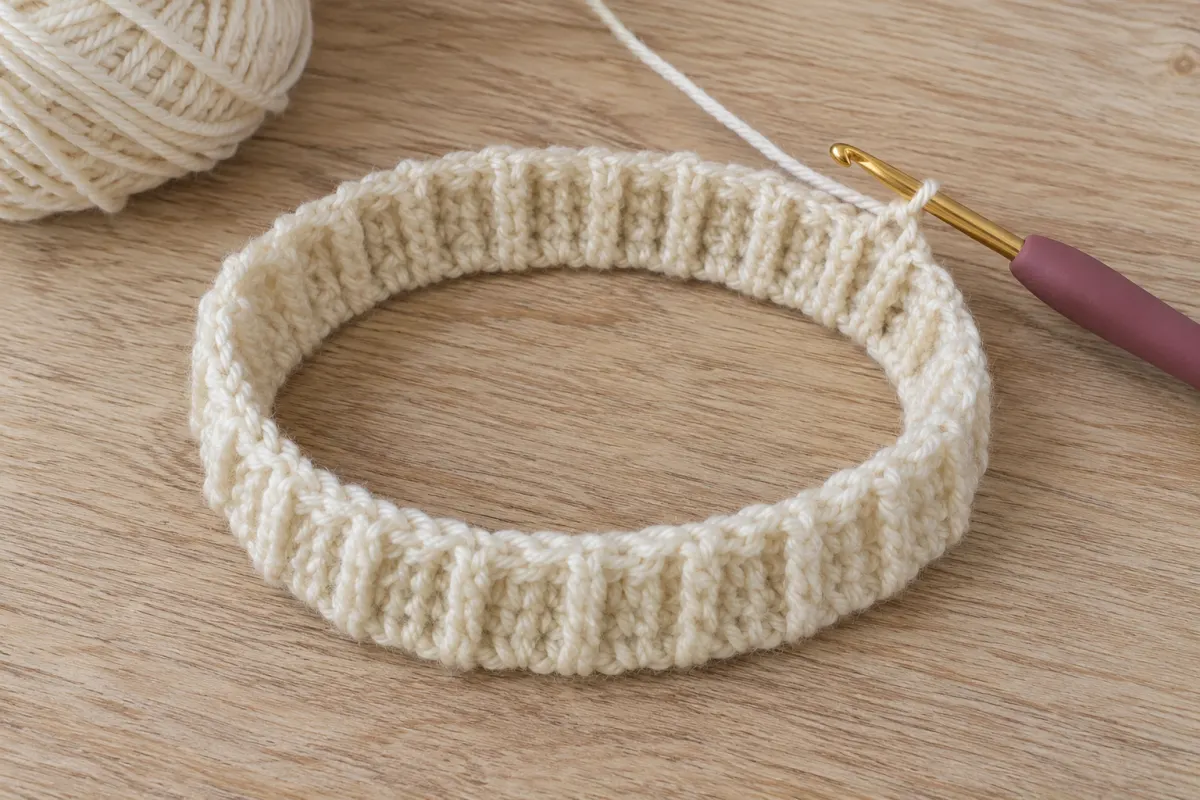
At the neck edge, with MC and the smaller hook, loosely chain 48 (52, 56, 64, 68, 76). Join in a round and place a marker on the first stitch.
- Round 1: Ch 2. Work 1 hdc in each chain around. Join: 48 (52, 56, 64, 68, 76) hdc.
- Round 2: Ch 2. *Work 1 dcfp around the post of the next stitch, then 1 hdc in the next hdc. Repeat from * around. Join with a slip stitch to the first dcfp. Repeat this last round twice more.
Change to the larger hook and work Chart I (II, II, III, III, IV) to its end. Work each chart repeat 12 (13, 14, 16, 18, 20) times, reading rounds from right to left. The resulting count is 192 (208, 224, 256, 288, 320) stitches. Break A.
With MC only, continue in rounds of splsc until the yoke, measured from the first chart round, reaches the source's printed line: 9¾ (10¾, 1¾, 11½, 11½, 13) inches [30.5 (30.5, 30.5, 30.5, 35.5, 35.5) cm].
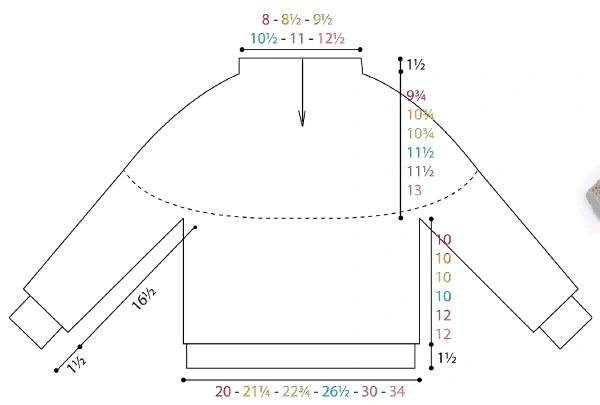
Important source measurement note: The printed L value is 1¾ inches, while the supplied schematic shows 10¾ inches in that size position. Several inch and centimeter values in this written line also disagree. Both references are retained rather than selecting a replacement measurement by assumption. This is an unresolved fit instruction in the supplied source.
 Save
Divide and work the body
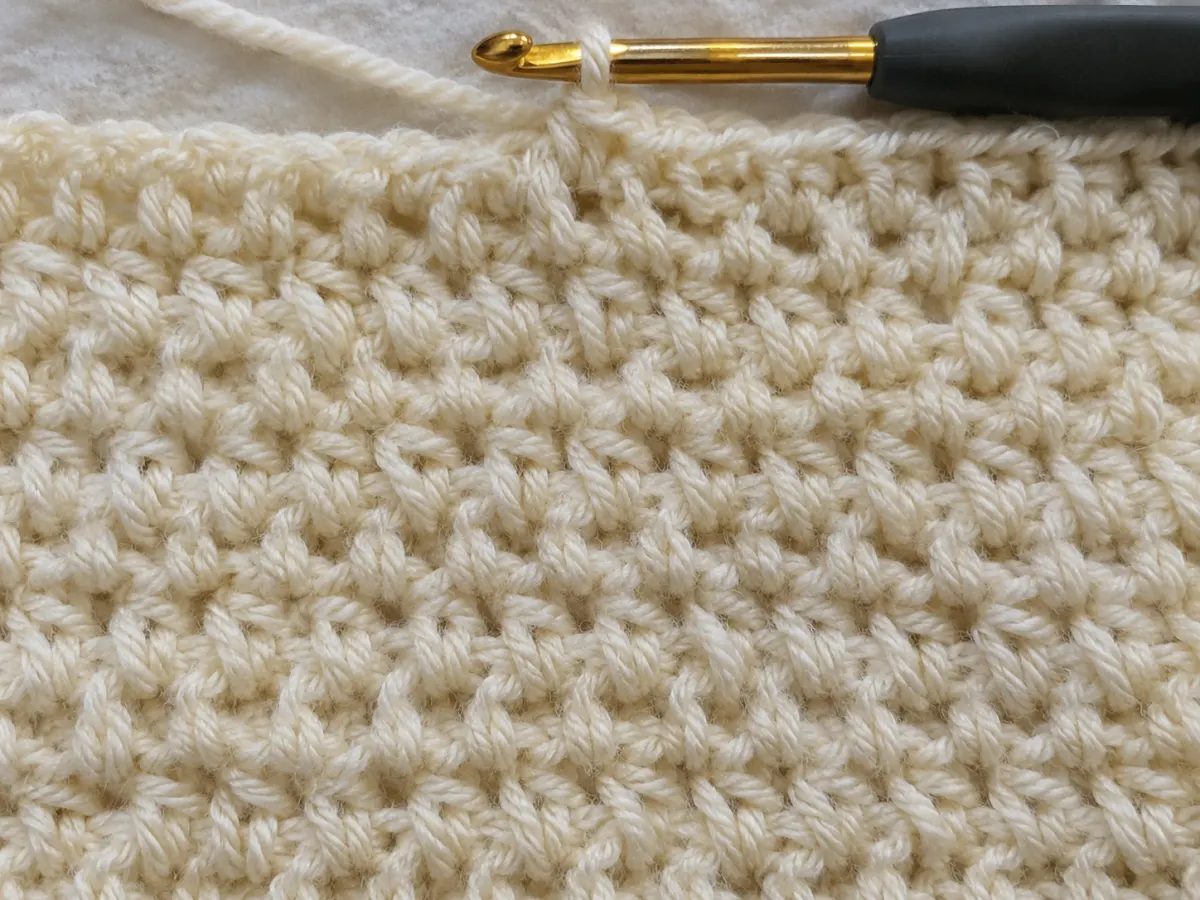
Use the smaller hook for the body and sleeves. For the dividing round, ch 1. Work 1 sc in each of the next 58 (62, 66, 78, 88, 100) sc for the front. Ch 2 and skip the next 38 (42, 46, 50, 56, 60) sc for the left sleeve. Work 1 sc in each of the next 58 (62, 66, 78, 88, 100) sc for the back. Ch 2 and skip the last 38 (42, 46, 50, 56, 60) sc for the right sleeve. Join. Place a marker between the last two chains for the beginning of the round. There are 120 (128, 136, 160, 180, 204) body stitches, counting sc and chain spaces.
- Next round: With MC, ch 1. *Work 1 sc in the next stitch, then 1 dc in the next stitch. Repeat from * around. Join.
- Next round: Ch 3 and skip the first sc. *Work 1 sc in the next dc, then 1 dc in the next sc. Repeat from * to the last dc. Work 1 sc in that last dc. Join.
- Next round: Ch 1. *Work 1 sc in the next dc, then 1 dc in the next sc. Repeat from * around. Join.
Repeat the last two rounds until the body measures 12 (12, 12, 12, 13½, 13½) inches [30.5 (30.5, 30.5, 30.5, 35.5, 35.5) cm] from the dividing round. These are the supplied paired measurements, not recalculated conversions.
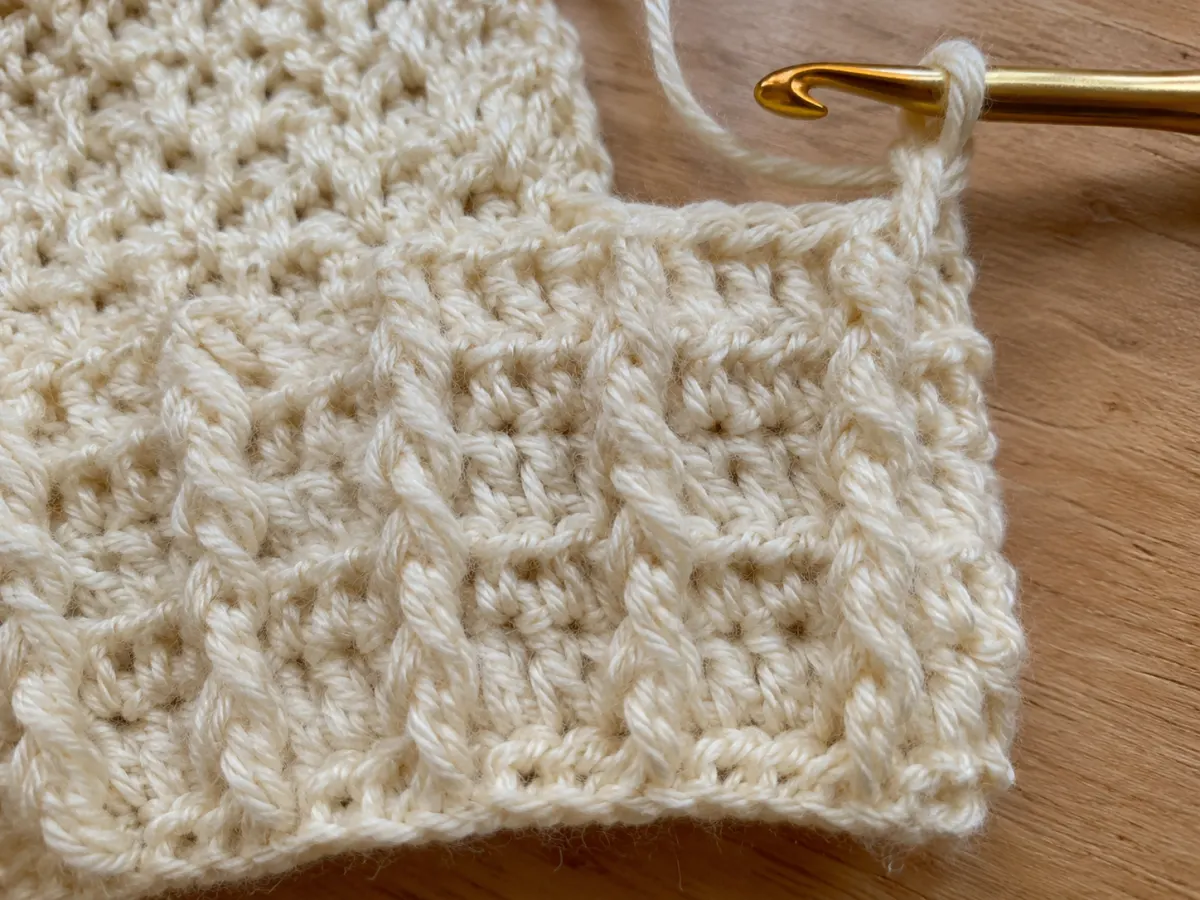
For the ribbing, ch 2 and work 1 hdc in each stitch around. Join with a slip stitch to the first hdc. On the next round, ch 2. *Work 1 dcfp around the next stitch post, then 1 hdc in the next hdc. Repeat from * around. Join with a slip stitch to the first dcfp. Repeat this last round three more times and fasten off.
 Save
Work both sleeves
With the smaller hook, join MC with a slip stitch to the second chain at the underarm.
- Round 1: Ch 1. Work 1 sc in the same space as the slip stitch, 1 sc in each sc to the last chain, then 1 sc in that last chain. Join: 40 (44, 48, 54, 58, 62) sc. Place a marker for the beginning of the round.
- Round 2: Ch 1. *Work 1 sc in the next stitch, then 1 dc in the next sc. Repeat from * around. Join.
- Round 3: Ch 3 and skip the first sc. *Work 1 sc in the next dc, then 1 dc in the next sc. Repeat from * to the last dc. Work 1 sc in that last dc. Join.
- Round 4: Ch 1. *Work 1 sc in the next dc, then 1 dc in the next sc. Repeat from * around. Join. Repeat the last two rounds in pattern until the sleeve measures approximately 2 inches [5 cm] from the dividing round.
On the next round, ch 2, hdc2tog, work in pattern to the last two stitches, and hdc2tog. Join. Work 4 (3, 2, 2, 2, 1) rounds even in pattern. On the next round, ch 2, hdc2tog, work in pattern to the last two stitches, and hdc2tog. Join. Repeat the last 5 (4, 3, 3, 3, 2) rounds 3 (5, 7, 9, 9, 11) more times. The supplied remaining count is 30 (30, 30, 32, 34, 34) stitches.
Continue even in pattern until the sleeve measures 16½ inches [42 cm] from the dividing round. For ribbing Round 1, ch 2 and work 1 hdc in each stitch around, then join. For Round 2, ch 2. *Work 1 dcfp around the next stitch post, then 1 hdc in the next hdc. Repeat from * around and join with a slip stitch to the first dcfp. Repeat this last round twice more, then fasten off.
 Save
Finishing and source schematic
Pin the garment to the measurements, cover it with a damp cloth and leave the cloth to dry, as directed in the source. The schematic below is preserved because it supplies garment proportions and another yoke measurement reference. A browser image is not a full-size template, so read its written measurements instead of measuring pixels on the screen.
 Save
Useful questions
Is the whole sweater worked in split single crochet?
No. The yoke uses split single crochet. After division, the body and sleeves use the written alternating single- and double-crochet pattern with the smaller hook. The edges use hdc and front-post double crochet ribbing.
Which chart should I use for size L?
Size L uses Chart II, repeated fourteen times. Its final charted stitch count is 224. Keep that size position throughout the remaining sequences, while also reading the explicit source measurement discrepancy.
Has the conflicting yarn quantity been corrected?
No. The ball counts and yardages are both retained as printed, with a clear note that they do not agree. No unverified substitute quantity is presented as a confirmed correction.
Are the inch and centimeter yoke measurements interchangeable here?
Not reliably: the supplied line contains conflicts and the L inch value differs from the schematic. The discrepancy is shown openly rather than hidden by a guessed conversion or an invented fit recommendation.
Keep the size table, assigned chart and written source notes together when planning this sweater. For more project updates, visit our Facebook page and Pinterest page.