


Playtime Sandwich Crochet Pattern: Bread, Lettuce, Tomato and Cheese
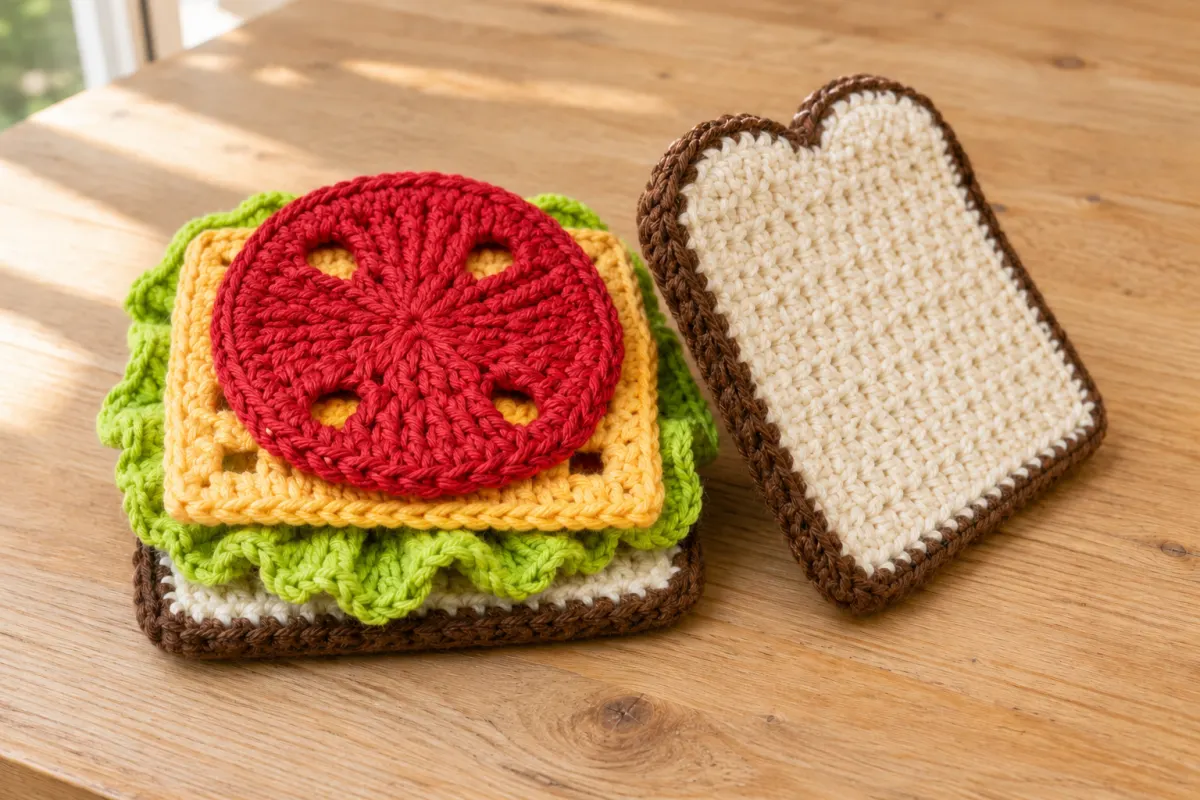
This playtime sandwich is made entirely from crochet: two bread slices, a ruffled lettuce circle, a red tomato layer and a yellow cheese square. The different shapes provide a compact collection of techniques, from straight single-crochet rows to circular increases and chain-space openings. The brown edging gives the cream bread a recognizable crust, while two curved groups at its upper edge suggest the rounded top of a loaf slice.
 Save
The source rates the pattern as easy and uses US crochet terms. Bread is specified as approximately 5 inches [12.5 cm] square. The layers are separate pieces rather than a stuffed sandwich sewn closed around its edge. This guide preserves the supplied component instructions and counts, including the source's skipped cheese-row number, without inventing a missing row.
Materials, hook and gauge
- Main Color, MC: Soft Ecru (01004).
- Contrast A: Warm Brown (01130), for the bread crust.
- Contrast B: Hot Green (01712), for the lettuce.
- Contrast C: Red (00095), for the tomato.
- Contrast D: Yellow (00010), for the cheese.
- US G/6 (4 mm) crochet hook, or a size needed to obtain gauge.
The supplied yarn specification is 2.5 oz/70.9 g and 120 yds/109 m. The source does not provide a per-color ball quantity, a yarn-weight category or a stuffing requirement for this design. Those details are not filled in by assumption. Keep the actual yarn specification with your supply notes rather than treating a guessed quantity as part of the original instructions.
Gauge is 15 sc and 16 rows to 4 inches [10 cm]. Check the flat bread section against that gauge and against its written length before working the curved top. The source's finished bread measurement applies to the whole outlined slice, not just the straight rectangle before shaping and edging.
Abbreviations and reading the pattern
Approx means approximately; beg means beginning; ch means chain; dc means double crochet; hdc means half double crochet; rep means repeat; rnd means round; RS means right side; sc means single crochet; sl st means slip stitch; sp means space; st means stitch; and WS means wrong side. The right and wrong sides identify orientation in the written directions rather than different yarn colors.
Pay particular attention to beginning chains. In the lettuce's first four rounds, chain 2 does not count as a half double crochet. Its later beginning chain 3 does count as a double crochet. The tomato and cheese directions also specify a counted chain 3. Retaining those distinctions helps keep a turning or joining chain from becoming an extra stitch.
Crochet two bread slices
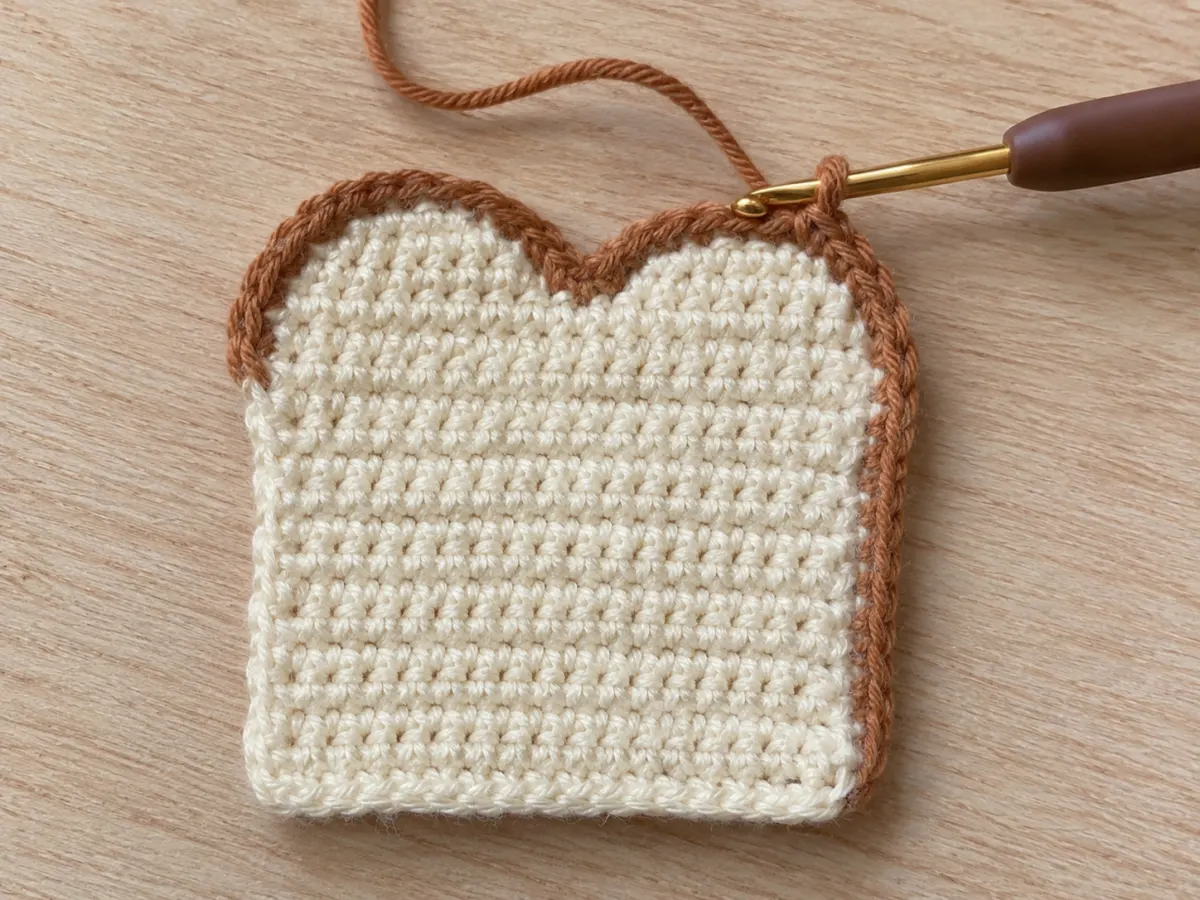
With MC, chain 16.
- Row 1, RS: Work 1 sc in the second chain from the hook and 1 sc in every remaining chain. Turn: 15 sc.
- Row 2: Ch 1, work 1 sc in each sc to the end, and turn.
Repeat Row 2 until the piece measures 3½ inches [9 cm] from the beginning, ending on a WS row. On the next RS row, follow the source's curved-top sequence: *skip the next three sc and work 7 dc in the next sc.** Skip the next three sc and slip stitch in the next sc. Repeat from * to ** once more. Skip the next two sc and slip stitch in the last sc. Do not turn.
The double-asterisk boundary ends immediately after the seven double crochets, so the second pass repeats that marked section only. The slip stitch between the two curved groups belongs to the first pass through the written line. Keeping the repeat boundary intact preserves the two distinct bread-top curves rather than adding a third group.
For Edging Round 1, ch 1 and work one round of sc evenly around the bread, placing 3 sc in each bottom corner. Join A with a slip stitch to the first sc. For Edging Round 2, with A, ch 1 and work 1 sc in each sc around, placing 3 sc in each corner. Join with a slip stitch to the first sc and fasten off. Make a second slice the same way.
 Save
Crochet the ruffled lettuce
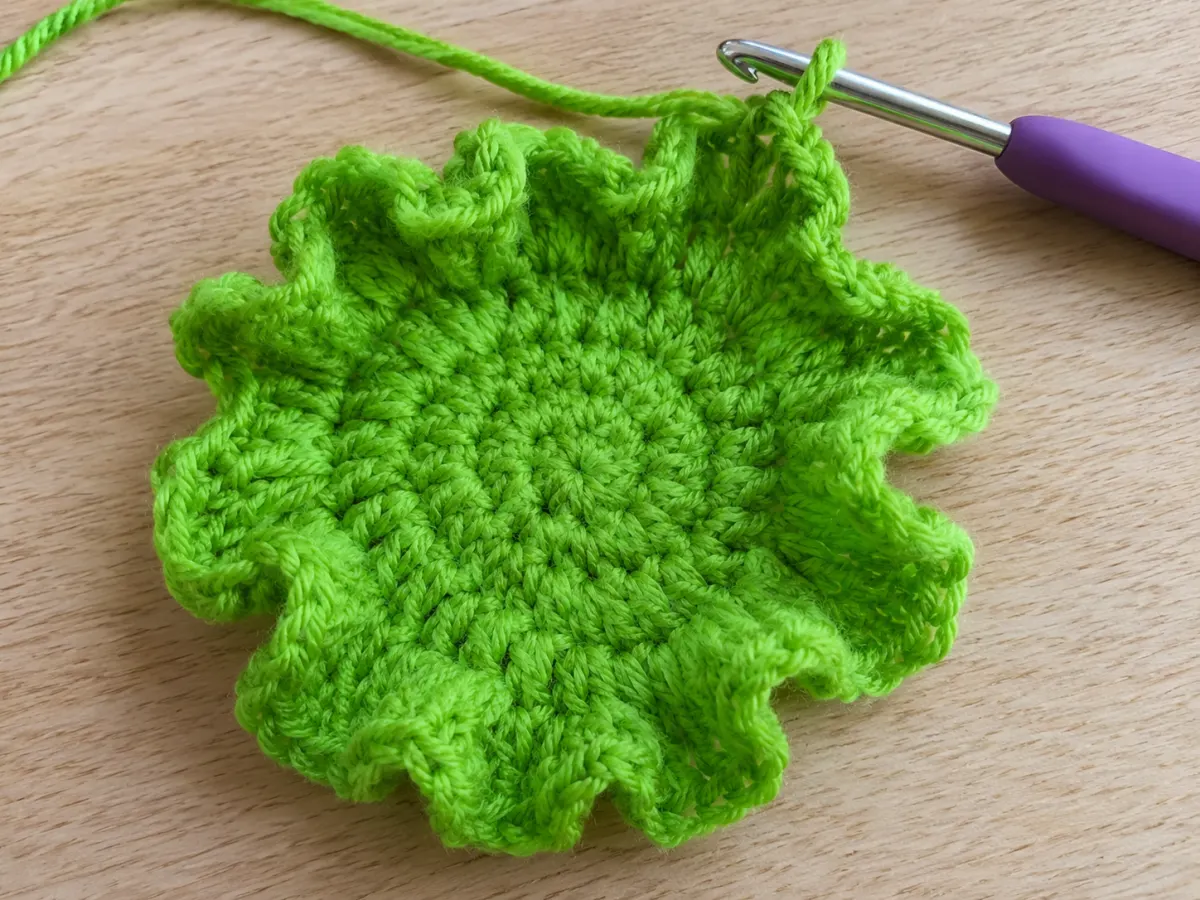
With B, chain 4 and join with a slip stitch to make a ring.
- Round 1: Ch 2, which does not count as hdc. Work 8 hdc in the ring. Join to the first hdc.
- Round 2: Ch 2, not counting as hdc. Work 2 hdc in each hdc around. Join to the first hdc: 16 hdc.
- Round 3: Ch 2, not counting as hdc. *Work 1 hdc in the next hdc, then 2 hdc in the next hdc. Repeat around. Join to the first hdc: 24 hdc.
- Round 4: Ch 2, not counting as hdc. *Work 1 hdc in each of the next two hdc, then 2 hdc in the next hdc. Repeat around. Join to the first hdc: 32 hdc.
- Round 5: Ch 3, counting as dc, and work 1 dc in the first hdc. *Work 2 dc in the next hdc, then 1 dc in the next hdc. Repeat around and join to the top of chain 3. The supplied count is 48 dc.
- Round 6: Ch 3, counting as dc, and work 2 dc in the first dc. Work 3 dc in each dc around. Join to the top of chain 3 and fasten off: 144 dc.
The final increase round produces the ruffled edge. Do not flatten it by omitting the three-double-crochet groups or replacing the final count with an earlier-round count. The source's Round 5 wording and its 48-dc total are retained as supplied; no additional stitch placement is invented to alter that printed sequence.
 Save
Crochet the tomato layer
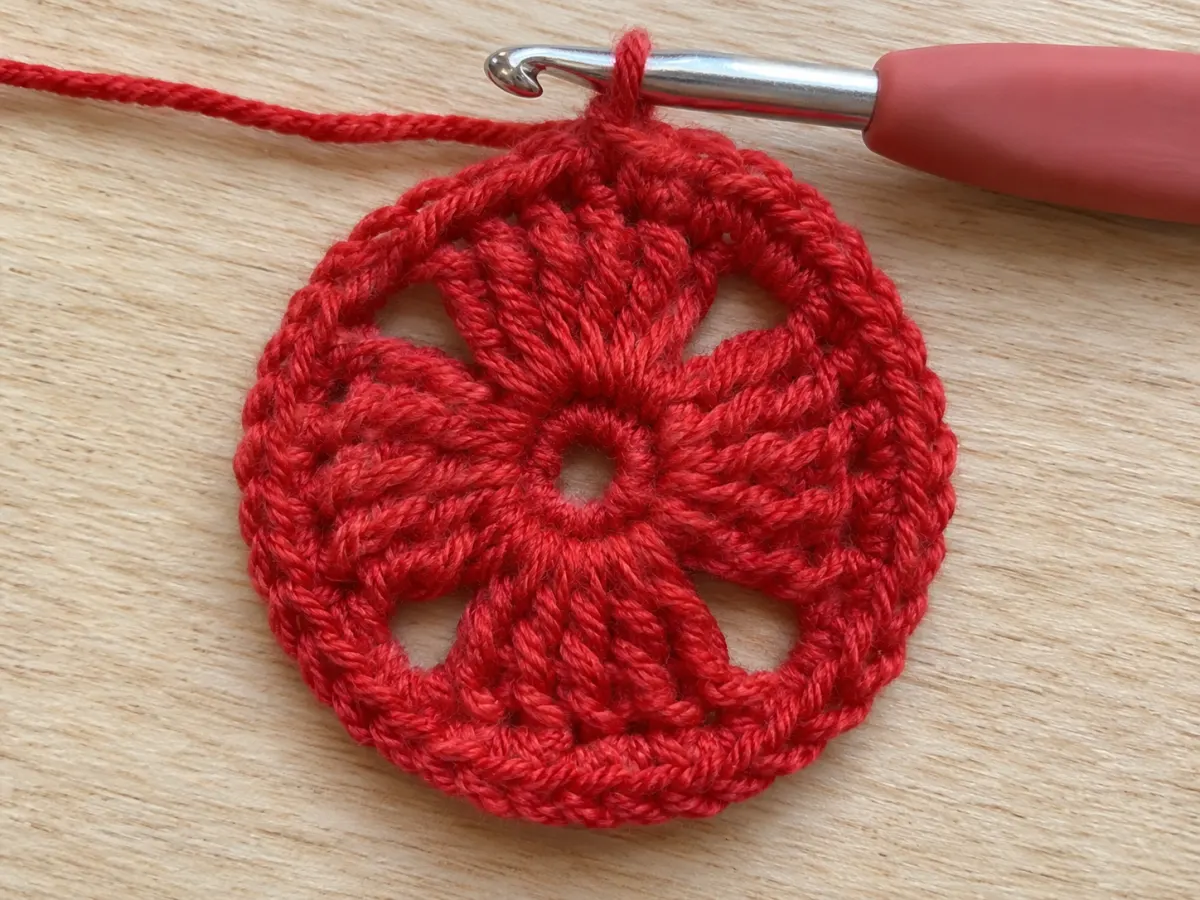
With C, chain 4 and join with a slip stitch to form a ring.
- Round 1: Ch 3, counting as dc. Work 2 dc in the ring. Work (ch 3, 3 dc) three times in the ring, then ch 3. Join to the top of chain 3.
- Round 2: Ch 3, counting as dc. Work 1 dc in the first dc and 2 dc in each of the next two dc. Work (ch 3, 2 dc in each of the next three dc) three times. Ch 3 and join to the top of chain 3.
- Round 3: Ch 1. Work (1 sc in each of the next six dc, 3 sc in the next ch-3 space) four times. Join to the first sc and fasten off.
The open chain spaces distinguish the tomato layer from the dense bread surface. Work the final sc groups into the named chain spaces, rather than treating each individual chain as a separate named space. The source does not add embroidered seeds, a green stem or a second tomato piece.
 Save
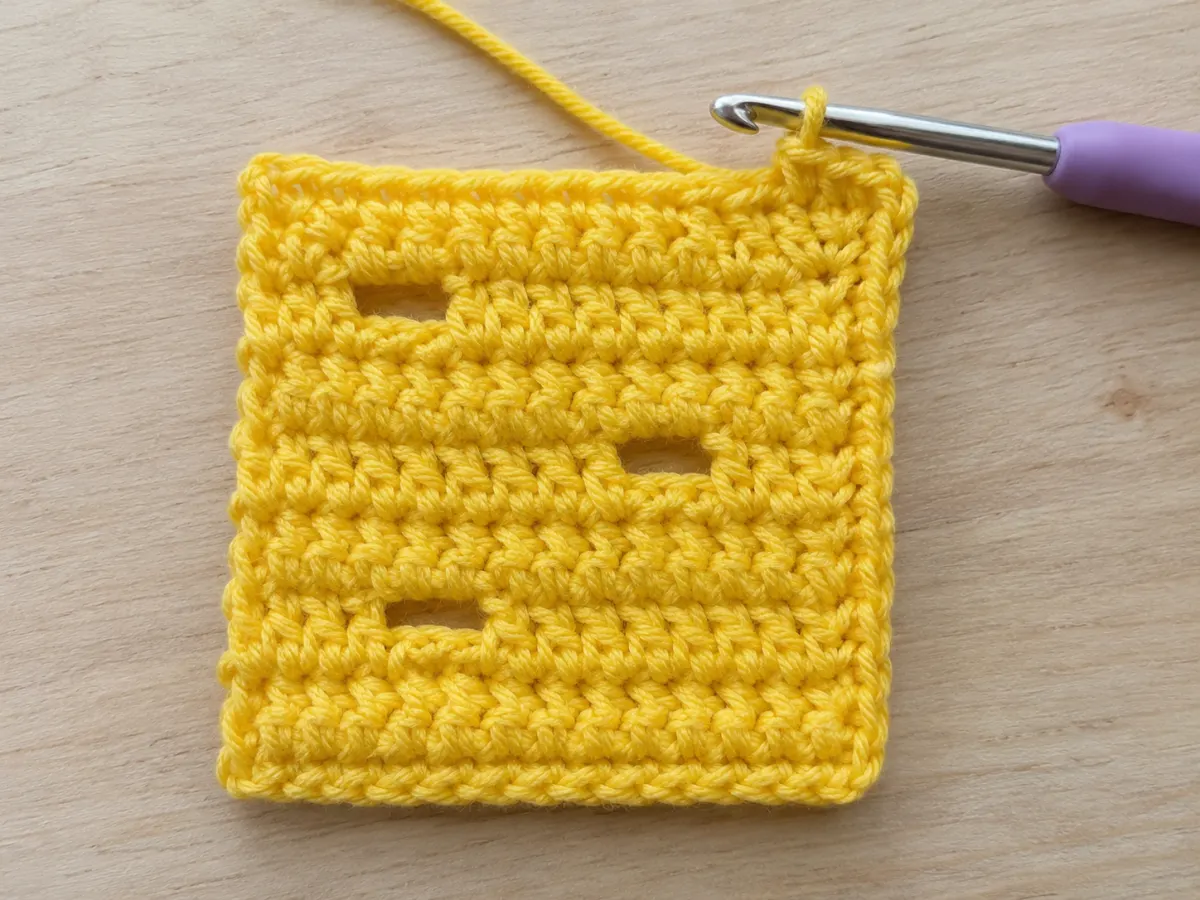
Crochet the cheese square
With D, chain 17.
- Row 1, RS: Work 1 dc in the fourth chain from the hook, counting the beginning as two dc, then 1 dc in every remaining chain. Turn.
- Row 2: Ch 3, counting as dc. Work 1 dc in each of the next two dc. Ch 2, skip the next two dc, and work 1 dc in each remaining dc. Turn.
- Row 3: Ch 3, counting as dc. Work 1 dc in each dc to the ch-2 space, 2 dc in that space, and 1 dc in each dc to the end. Turn.
- Row 4: Ch 3, counting as dc. Work 1 dc in each of the next eight dc. Ch 2, skip the next two dc, and work 1 dc in each dc to the end. Turn.
- Row 5: Repeat Row 3.
- Row 6: Ch 3, counting as dc. Work 1 dc in each of the next three dc. Ch 2, skip the next two dc, and work 1 dc in each dc to the end. Turn.
- Row 8, as numbered in the source: Repeat Row 3. Do not turn.
Source numbering note: The supplied PDF goes from Row 6 directly to Row 8, with no written Row 7. All three source pages have been checked; the final page supplies photographs, not an additional hidden row. No guessed Row 7 is inserted and the remaining row is not silently renumbered. This preserves the supplied sequence while making its limitation clear.
For the cheese edging, ch 1 and work one round of sc evenly around its outer edge, placing 3 sc in each corner. Join to the first sc and fasten off. The chain-space openings are part of the cheese fabric, not holes cut into a completed square.
 Save
Arrange and finish the separate layers
The supplied design shows the lettuce, cheese and tomato between the two bread slices. It does not provide a permanent sewing-together step, a stuffing step or a fastening method for the assembled sandwich, so none is added here. Keep the pieces separate in the same way the individual component instructions finish them.
Check that each component has its own fastened-off end and that no tool remains tucked between the layers. These are general handling checks, not a claim that the project has been safety tested. The title “Playtime” does not establish suitability for a particular child's age. No testing, firsthand use or safety certification is claimed.
Useful questions
How many bread pieces should I make?
Make two. Each uses the same 15-sc straight section, two curved top groups and two edging rounds. The brown crust is the second edging round, not a separate fabric strip sewn onto the bread.
Does the lettuce remain flat?
The final round places three double crochets in each stitch and ends with the supplied 144-dc count. Its ruffled appearance belongs to that increase structure. The written pattern does not call for reducing it into a flat disk.
Has Cheese Row 7 been reconstructed?
No. The missing number and missing instruction are explicitly noted. The article retains Rows 1–6 followed by the source's Row 8 without inventing a technical step.
Are extra yarn quantities supplied here?
No per-color ball quantity appears in the supplied pattern. The listed colors and ball specification are retained, but an estimated shopping quantity is not presented as if it came from the source.
Work one component at a time, keep the counted beginning chains clear, and stack the separate crochet layers when finished. For more project updates, visit our Facebook page and Pinterest page.