


Smarty Pants Crochet Baby Trousers: Four-Size Pattern
Edited by Nora
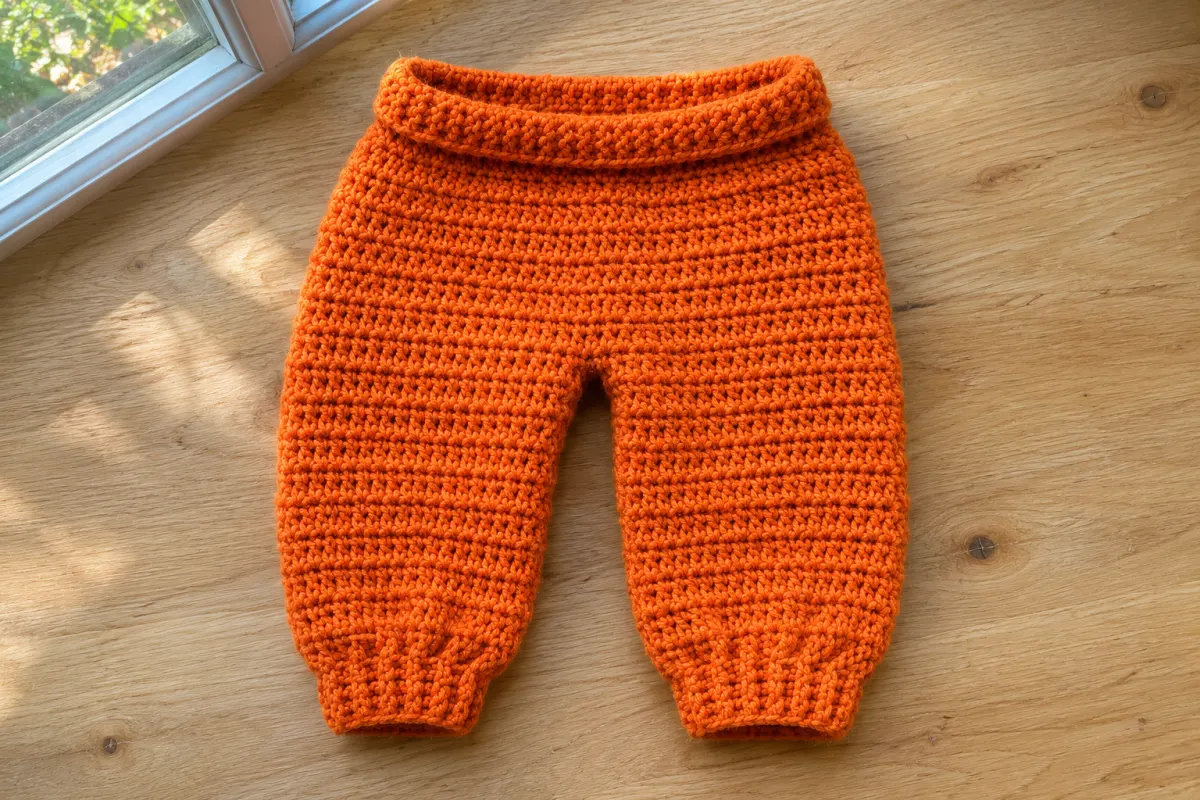
Smarty Pants are crocheted from the waistband down, with a shaped back, a divided crotch and ribbed cuffs. The main fabric uses half double crochet, while double crochet adds height to the back shaping. The folded waistband holds elastic, so the finished trousers do not rely on a drawstring to stay in place.
This guide follows the four sizes in the supplied pattern: 6, 12, 18 and 24 months. Choose one size before starting and keep that position consistent throughout every group of numbers. Age labels are only the names of the sizes here; use the stated waist measurements and gauge rather than assuming that an age label guarantees a particular child's fit.
 Save
Materials, tools and size order
The size order throughout is 6 (12-18-24) months. When there is only one number, it applies to every size. The source recommends circling the numbers for your selected size before beginning; that is particularly useful where the back shaping, leg lengths and cuff decreases use different number groups.
- To fit waist: 6 months: 17 inches [43 cm]; 12 months: 18 inches [45.5 cm]; 18 months: 19 inches [48 cm]; 24 months: 20 inches [51 cm].
- Yarn: Pumpkin (53630), supplied in balls of 7 oz/197 g and 426 yds/389 m.
- Quantity: 1 ball for 6 months, 1 ball for 12 months, 1 ball for 18 months, or 2 balls for 24 months.
- Hook: Size U.S. H/8 (5 mm), or size needed to obtain gauge.
- Elastic: a length of ¾-inch [2 cm] wide elastic to fit the waist measurement.
Gauge: 13 hdc and 10 rows = 4 inches [10 cm]. The finishing instructions include sewing the casing, joining the elastic and closing any crotch gaps. Keep appropriate sewing supplies available for those operations; the source does not specify a separate sewing-needle size.
Abbreviations and special stitches
Approx = approximately; beg = beginning; dc = double crochet; hdc = half double crochet; rem = remaining; rep = repeat; rnd = round; RS = right side; sl st = slip stitch; sp = space; st = stitch; WS = wrong side; and yoh = yarn over hook. Ch means chain. These are US crochet terms.
- Dctbl: double crochet through back loop only.
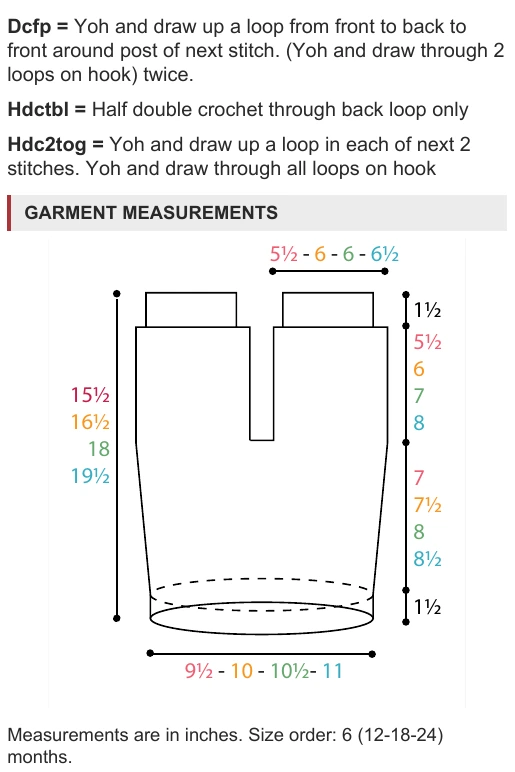
- Hdctbl: half double crochet through back loop only.
- Dcfp: Yoh and draw up a loop from front to back to front around post of next stitch. (Yoh and draw through 2 loops on hook) twice.
- Hdc2tog: Yoh and draw up a loop in each of next 2 stitches. Yoh and draw through all loops on hook.
Understand the construction before crocheting
The trousers are worked in one piece in the round from the waist edge down. The source asks you to turn at the end of each round to prevent the stitches from slanting to a bias. This is not a continuous-spiral method: joining and turning are part of the instructions, even though the fabric is described as being worked in rounds.
Work the first hdc of each round in the same stitch as the last joining space of the previous round. The ch 2 at the beginning of each round does not count as a stitch. Keep that rule in mind when checking the round totals so that the starting chain is not accidentally counted as an extra half double crochet.
Back shaping changes the height of a section without asking for an increase in the overall stitch count. Follow the specified blocks of hdc and dc in the order given. Do not add an increase just because the back appears taller than the front; that difference is part of the intended construction.
Waistband and upper section
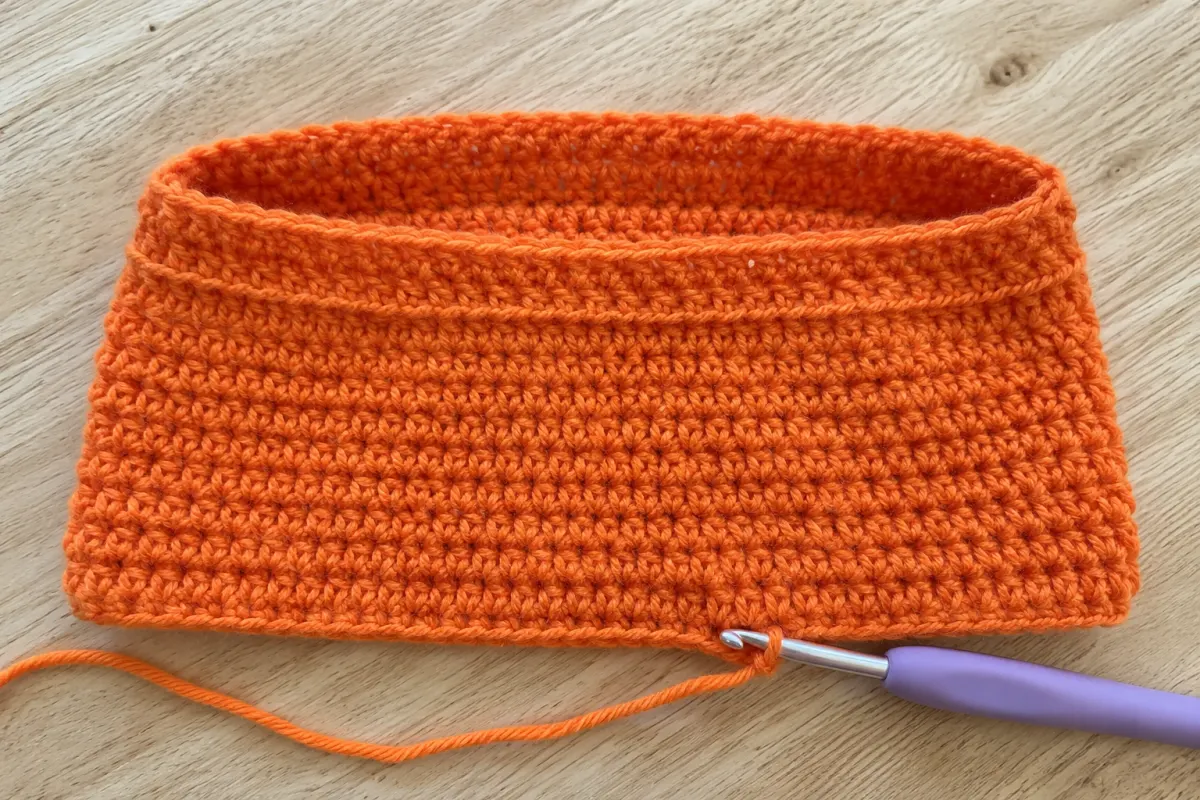
Foundation: Beginning at the waist edge, ch 60 (64-68-72). Join with a sl st to the first chain to form a ring, taking care not to twist the chain.
- Round 1 (RS): Ch 2. 1 hdc in first ch. 1 hdc in each ch around. Join with sl st to first hdc. Turn. 60 (64-68-72) hdc.
- Round 2 (WS): Ch 2. 1 hdc in each hdc around. Join with sl st to first hdc. Turn.
- Round 3 (RS, fold line): Ch 2. 1 hdctbl in each hdc around. Join with sl st to first hdc. Turn.
- Round 4: As the second round.
Shape the back
- Round 5 (RS): Ch 2. 1 hdctbl in each of first 4 sts. 1 dctbl in each of next 22 (24-26-28) sts. 1 hdctbl in each st to end of rnd. Join with sl st to first hdc. Turn.
- Round 6 (WS): Ch 2. 1 hdc in each of first 5 sts. 1 dc in each of next 20 (22-24-26) sts. 1 hdc in each st to end of rnd. Join with sl st to first hdc. Turn.
- Round 7 (RS): Ch 2. 1 hdc in each of first 6 sts. 1 dc in each of next 18 (20-22-24) sts. 1 hdc in each st to end of rnd. Join with sl st to first hdc. Turn.
- Round 8 (WS): Ch 2. 1 hdc in each of first 7 sts. 1 dc in each of next 16 (18-20-22) sts. 1 hdc in each st to end of rnd. Join with sl st to first hdc. Turn.
- Round 9 (RS): Ch 2. 1 hdc in each st around. Join with sl st to first hdc. Turn.
- Round 10 (WS): Ch 2. 1 hdc in each st around. Join with sl st to first hdc. Turn.
Repeat the last two rounds until work from the fold-line round measures approximately 7 (7½-8-8½) inches [18 (19-20.5-21.5) cm] at center front, ending on a WS round. Measure from the stated fold line rather than from an arbitrary edge of the casing.
 Save
Left leg and cuff
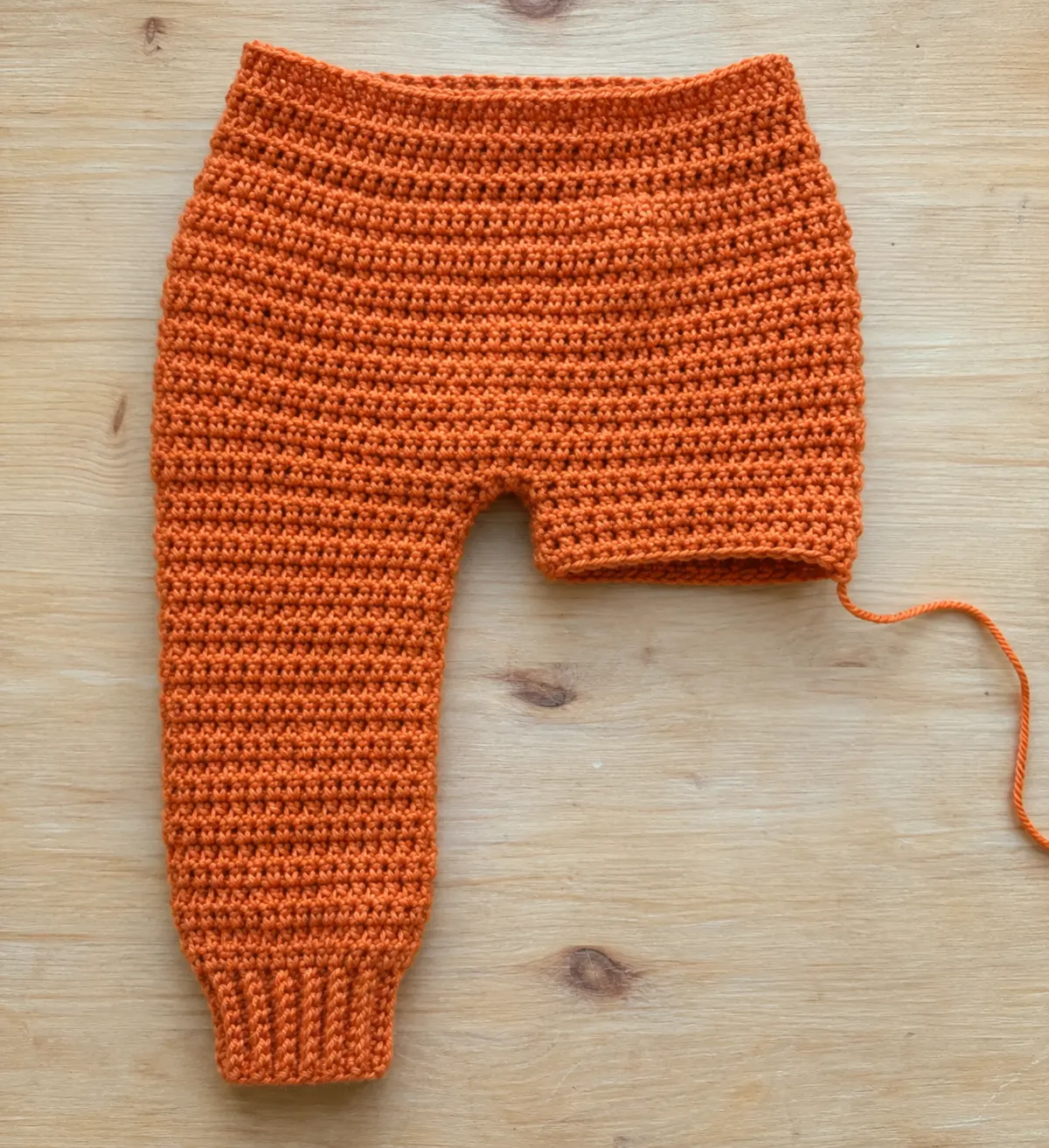
- Round 1 (RS): Ch 2. 1 hdc in each of first 15 (16-17-18) sts. Ch 5 for crotch. Skip next 30 (32-34-36) sts. 1 hdc in each of last 15 (16-17-18) sts. Join with sl st to first hdc. Turn.
- Round 2 (WS): Ch 2. 1 hdc in each of first 15 (16-17-18) sts. 1 hdc in each of next 5 ch. 1 hdc in each of last 15 (16-17-18) sts. Join with sl st to first hdc. Turn. 35 (37-39-41) hdc.
- Round 3 (RS): Ch 2. 1 hdc in each st around. Join with sl st to first hdc. Turn.
- Round 4 (WS): Ch 2. 1 hdc in each st around. Join with sl st to first hdc. Turn.
Repeat rounds 3 and 4 until the leg from the crotch measures approximately 5½ (6-7-8) inches [14 (15-18-20.5) cm], ending on a WS round.
Next round (RS): Ch 2. *1 hdc in each of next 3 (2-2-2) hdc. Hdc2tog. Repeat from * to last 0 (1-3-5) stitch(es). 1 hdc in each of last 0 (1-3-5) hdc. Join with sl st to first hdc. 28 (28-30-32) sts. Do not turn.
Next round (RS): Ch 2. *1 dcfp around next hdc. 1 hdc in next hdc. Repeat from * around. Join with sl st to first st. Repeat this last round 3 times more. Fasten off.
 Save
Right leg
- Round 1 (RS): Join yarn with sl st in remaining loop of center ch-5 of crotch. Ch 2. 1 hdc in same sp as last sl st. 1 hdc in each of next 2 ch. 1 hdc in each of next 30 (32-34-36) hdc. 1 hdc in each of last 2 ch. Join with sl st to first hdc. Turn.
- Round 2 (WS): Ch 2. 1 hdc in each st around. Join with sl st to first hdc. Turn.
Continue by repeating the left-leg instructions from round 3 through the completed cuff and fastening off. Those are the source's ** to ** repeat boundaries; do not repeat the left-leg foundation division when working the right leg.
Garment measurements and finishing
 Save
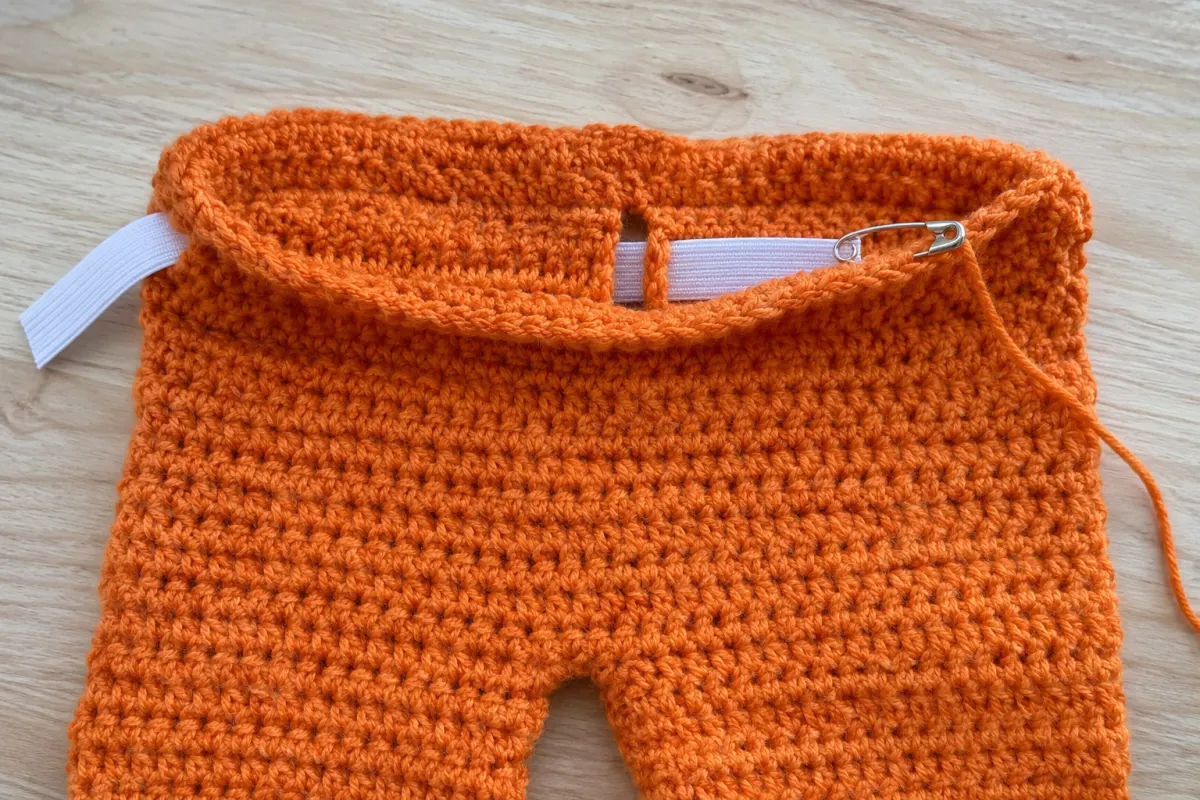
Fold the waistband in half along the fold line to the WS and sew it in position, leaving an opening at center back for the elastic. Cut the elastic to fit the waist measurement plus 1 inch [2.5 cm] for joining. Insert it into the waistband and join its ends securely. Sew the waistband opening closed.
Sew any gaps at the crotch closed on the WS if necessary and fasten securely. Before closing the casing, check that the elastic has not twisted inside it. Keep the sewing secure without catching the elastic along its full length, so that the intended elastic casing can function rather than becoming a completely fixed waistband.
 Save
Useful questions and checks
Why do I turn when the pattern is worked in rounds?
The source specifically asks for turning to prevent bias slanting. Keep the join-and-turn sequence until the cuff instruction says not to turn. Changing the entire project to a spiral would change the construction and is not part of these directions.
Does the beginning ch 2 count?
No. The project note says it does not count as a stitch. This rule applies when checking the totals and locating the first hdc after a join.
How do I keep the two legs consistent?
Follow the same selected size and repeat boundaries for both legs. Record where the left-leg length repeat ended before starting the right leg. Do not use a different size column because a later number happens to look familiar.
Can I assume the age label guarantees fit?
No. The listed waist measurements and the stated gauge provide more useful information than the age label alone. No new stretch allowance, substitute gauge or fitting claim is added to the source figures.
What should I check before the final sewing?
Check the joins, crotch area and casing opening while they remain accessible. Keep the yarn label for care instructions, especially when using a substitute yarn. This guide does not claim that the trousers have been tested on a child or that every yarn substitution will behave identically.
Choose the size, keep the fold line easy to identify and work the leg repeats consistently. Finish the elastic casing only after the crocheted construction has been checked. For collection updates, visit our Facebook page and Pinterest page.